Speed Cameras: How They Work and Where They're Legal
Quick Answer
A speed camera uses radar or laser to measure passing vehicles and photographs only those going over a set threshold, often more than 10 mph above the limit. A reviewer checks the images, then a notice is mailed to the registered owner. Whether cameras are legal depends on your state: some allow them widely, some only in school or work zones, and some ban them. In many places the ticket is a civil fine with no license points.
On this page
Key Takeaways
- Speed cameras photograph the vehicle and its plate, not the driver, so most notices go to the registered owner.
- There are three main types: fixed cameras, mobile units and point-to-point systems that measure average speed.
- State law decides where cameras can run. Maine bans them, Florida allows them only in school zones, and Colorado lets any city adopt them.
- In New York City and Colorado, camera tickets carry no license points. Arizona is an exception where points can apply.
- The notice gives a deadline, often 30 days, to pay or contest through an official city or court site.
How do speed cameras work?
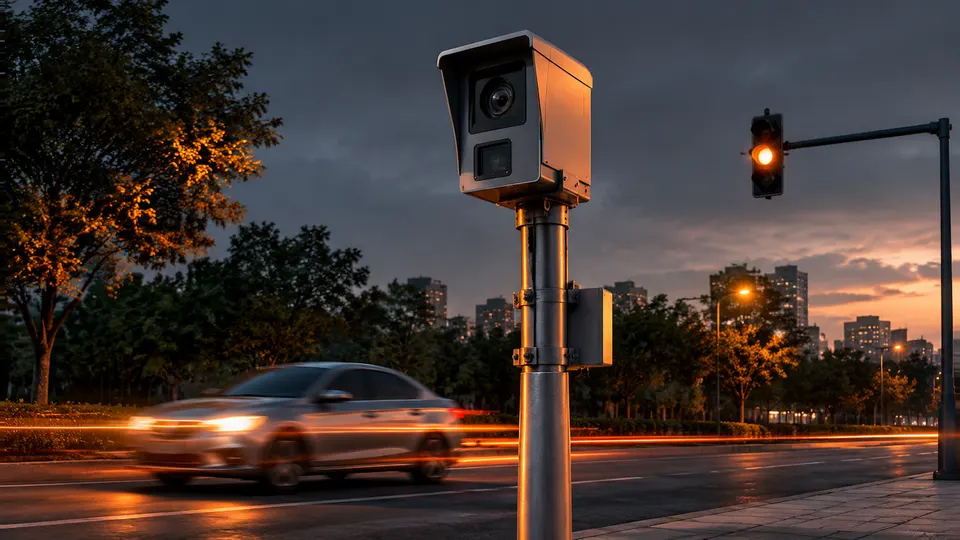
A speed camera is a speed measuring device tied to a camera. The federal Speed Safety Camera Program Planning and Operations Guide, published by the Federal Highway Administration and NHTSA, describes speed safety cameras (also called photo radar or automated speed enforcement) as systems that detect vehicles exceeding the speed limit and capture photo or video evidence of them [1].
New York City's program shows the steps clearly. The city uses the same radar and laser technology police use. If a vehicle is more than 10 mph over the limit, the system records images of the vehicle and its license plate. A trained city technician reviews each violation, and only then is a Notice of Liability mailed to the registered owner [2]. The cameras photograph only vehicles over the threshold, not every car that passes.
Most speed camera programs identify the vehicle, not the driver, which is why the notice goes to the owner. The federal guide notes that some programs use driver liability, which needs identity checks, while many hold the owner liable [1].
The threshold matters. The guide says there is no single threshold that fits every site, and that some jurisdictions start at 11 mph over the limit [1]. Florida's school zone law, for example, applies only to drivers more than 10 mph over the school zone limit [7].
What types of speed cameras are there?
The federal guide describes three main setups [1]:
- Fixed cameras are installed at one location and stay there. They suit a known problem spot.
- Mobile units sit in a van or trailer and can move from site to site, which suits a speeding problem spread across a corridor or network.
- Point-to-point systems (also called average speed or speed-over-distance) record a vehicle at a first site and again at a second, time-synchronized site, then calculate the average speed between them.
The guide notes that U.S. experience with point-to-point systems is limited and that they are more common in places like Australia and the United Kingdom [1]. New York City uses both fixed and mobile units inside its school speed zones [2].
Where are speed cameras legal?
There is no national speed camera law: each state decides, and many states leave the question to cities. The Insurance Institute for Highway Safety (IIHS) counted speed safety cameras in 338 U.S. communities in 26 states and the District of Columbia during 2025 [4]. IIHS also keeps a state law table that is a useful cross-check [5].
State laws fall into four broad patterns. These examples are from each state's own statute or agency, as of November 2026:
| Pattern | Example | What the official source says |
|---|---|---|
| Banned | Maine | The state and towns may not use traffic surveillance cameras to enforce traffic laws, except school bus cameras and turnpike toll enforcement [6] |
| Limited | Florida | Speed cameras only in school zones, around school start and end times, for drivers more than 10 mph over [7] |
| Limited | New York City | Only in 750 school speed zones within a quarter mile of a school, running 24 hours a day since August 1, 2022 [2] |
| Allowed | Colorado | Cameras run in work zones, school zones and designated corridors, with a warning period before fines start [8] |
| No state law | Varies | Some states neither authorize nor ban cameras, so local rules and courts decide |
Laws change often, and several states voted on camera rules in 2026. For the current status in your state, see our traffic camera laws by state page, which lists the statute and the date we checked it.
Do speed camera tickets add points or raise insurance?
Usually not, but it depends on the state. In many programs a speed camera ticket is a civil fine against the vehicle owner, not a moving violation against the driver. The federal guide says camera violations may be treated as moving violations with license points in some places, but civil penalties are the most common sanction [1].
Official examples, as of November 2026:
- New York City: a speed camera violation is not added to the owner's DMV record, is not used for insurance purposes and adds no points, because the camera identifies the vehicle, not the driver [2].
- Colorado: drivers do not receive points for civil penalties from an automated speed enforcement system [8].
- Arizona (Scottsdale): photo enforcement convictions are reported to the state, and each speed conviction is assigned three points. Drivers who have not used the defensive driving option in the past 12 months can use it to avoid the points [9].
A ticket written by an officer is different. It is usually a moving violation that can add points and show up on your record. Our license points guide explains how point systems work, and the points calculator shows what a given ticket adds in your state. For the money side, see how a speeding ticket affects insurance.
What should you do if you get a speed camera notice?
Read the notice first. It names the agency, the date, the location, the speed recorded and the deadline. New York City requires a response within 30 days, and ignoring a notice can lead to late penalties and even the vehicle being booted or towed [2]. Florida gives the owner 30 days from the notice to pay, submit an affidavit or request a hearing [7].
Your options usually are:
- Pay through the official city or court website printed on the notice. Do not use a third-party payment site.
- Contest if you think the notice is wrong, for example a misread plate or a vehicle that was stolen. New York City accepts a police report for a stolen vehicle [2].
- Name the driver if your state allows it. Florida lets the owner file an affidavit about who had the vehicle [7].
Repeat notices can bring more than fines. In New York City, an owner with 15 or more notices in 12 months may have to take a safe vehicle operation course or risk impoundment [2]. If a notice could affect your license, or you drive commercially, talking to a licensed attorney in your state makes sense. Our state ticket guides cover the rules for each launch state, starting with New York.
Do speed cameras reduce crashes?
The research says they can. The federal guide estimates that speed safety cameras reduce roadway fatalities and injuries by 20 to 37 percent, and it cites studies for each camera type [1].
Local results point the same way. In Montgomery County, Maryland, IIHS found that about seven and a half years after cameras started, vehicles were 62 percent less likely to be going more than 10 mph over the limit, and crashes were 19 percent less likely to involve an incapacitating or fatal injury [4]. New York City reported in January 2025 that the average number of daily violations per camera dropped 94 percent [3].
The federal guide also says programs should be driven by safety data, not revenue, and should be open about how ticket money is used [1]. Red light cameras work in a similar way at intersections; see our red light camera guide.
Frequently Asked Questions
How fast do you have to go to get a speed camera ticket?
It depends on the program. New York City and Florida school zones ticket only drivers more than 10 mph over the limit [2]. Other places set a different threshold, and some do not publish it. The safe assumption is that any speed over the limit can be ticketed.
Does a speed camera ticket go on my driving record?
In many programs, no. New York City camera violations are not added to the DMV record or used for insurance [2]. Some states treat them differently, such as Arizona, where points can apply. Check the notice and your state DMV.
What if someone else was driving my car?
Most programs hold the registered owner responsible, whoever was driving. Some states let the owner name the driver or show the car was stolen, as Florida does with an affidavit [7].
How much is a speed camera ticket?
Camera fines are set by state or local law. Examples as of November 2026: $50 in New York City [2] and $75 in a Colorado work or school zone [8]. Officer-written tickets usually cost more; see how much a speeding ticket costs.
Our Take
We see speed cameras as one of the clearer parts of traffic law once you know the rules where you live. The federal guide and city data we cite show real safety gains, and most programs treat the ticket as a civil fine without points. What trips people up is the variety: a camera ticket in New York City and one in Arizona are handled very differently. Our advice is simple. Read the notice, note the deadline, and use only the official website printed on it. If the notice is wrong, contest it. If your license or job could be affected, get advice from a licensed attorney.
Sources
- Speed Safety Camera Program Planning and Operations Guide. FHWA and NHTSA, 2023.
- FAQs: Speed Cameras. NYC DOT, 2022.
- NYC DOT's Speed Cameras Achieved a 94 Percent Reduction in Speeding in Locations Where They Are Installed. NYC DOT, 2025.
- Speed. IIHS, 2026.
- Safety camera laws. IIHS, 2026.
- Maine Revised Statutes, Title 29-A, Section 2117. Maine Legislature, 2026.
- Florida Statutes, Section 316.1896. Florida Legislature, 2026.
- Colorado Speed Enforcement Program FAQ. Colorado DOT, 2026.
- Photo Enforcement. City of Scottsdale, 2026.
This is general information to help you understand your vehicle, not a substitute for a hands-on diagnosis. If a warning light is flashing or the car runs badly, stop driving and have it checked by a qualified technician. Spotted an error? Tell us.
Keep Reading
How Many Points Is a Speeding Ticket? State-by-State
A speeding ticket adds 0 to 11 points depending on the state and speed. How point systems work, suspension levels, states without points and camera tickets.
Red Light Cameras: How They Work and What a Ticket Means
How red light cameras catch a car entering on red, what the notice means for fines and points, right turn on red rules, where cameras are legal and what to do.

How Much Does a Speeding Ticket Raise Insurance?
A speeding ticket can raise car insurance, but by how much depends on your state, insurer and record. See the factors and what state insurance regulators say.

Speeding Ticket in Texas: Fines, Points and Options
Texas speeding tickets usually carry a fine of up to $200 plus court costs, doubled in work zones. No points, but 4 convictions in 12 months can suspend.

Speeding Ticket in Virginia: Fines, Points and Options
Virginia speeding fines start at $6 per mph over the limit, DMV adds 3 to 6 demerit points, and 20 over is reckless driving. Your options as of November 2026.

Speeding Ticket in North Carolina: Fines, Points and Options
A North Carolina speeding ticket adds 2 or 3 license points and 1 to 4 insurance points that raise rates 40% to 90%. See fines, suspensions and your options.