Why Does My Car Shake When I Brake?
Quick Answer
A car that shakes when you brake most often has brake rotors with uneven thickness, which makes the pads grab and release as the rotor turns. Sticking calipers, uneven pad wear, unbalanced or worn tires, and worn suspension parts cause it too. Treat it as a safety problem: get the brakes inspected soon, and stop driving if the pedal sinks, the car pulls hard, or you smell burning.
On this page
- What causes a car to shake when braking?
- Where do you feel the shake: steering wheel, pedal or seat?
- Is it safe to drive when your car shakes when braking?
- How can you narrow down the cause safely?
- Will a shaking brake set a check engine light or a code?
- What does the fix usually involve?
- Frequently Asked Questions
- Our Take
- Sources
Key Takeaways
- The most common cause is a brake rotor that has become uneven in thickness, often called "warped."
- A shaking steering wheel usually points to the front; a shaking seat or rear usually points to the rear brakes or tires.
- A sticking caliper, uneven pad wear, tire balance and worn suspension parts can all cause shaking under braking.
- Stop driving if the pedal sinks, the car pulls hard, you hear grinding, or you smell burning.
- Brake shaking rarely sets a check engine light. ABS problems may set C codes and an ABS warning light.
What causes a car to shake when braking?
Braking squeezes pads against a spinning rotor at each wheel. Anything that makes that squeeze uneven, or that loosens how the wheel is held, turns into a shake you can feel.
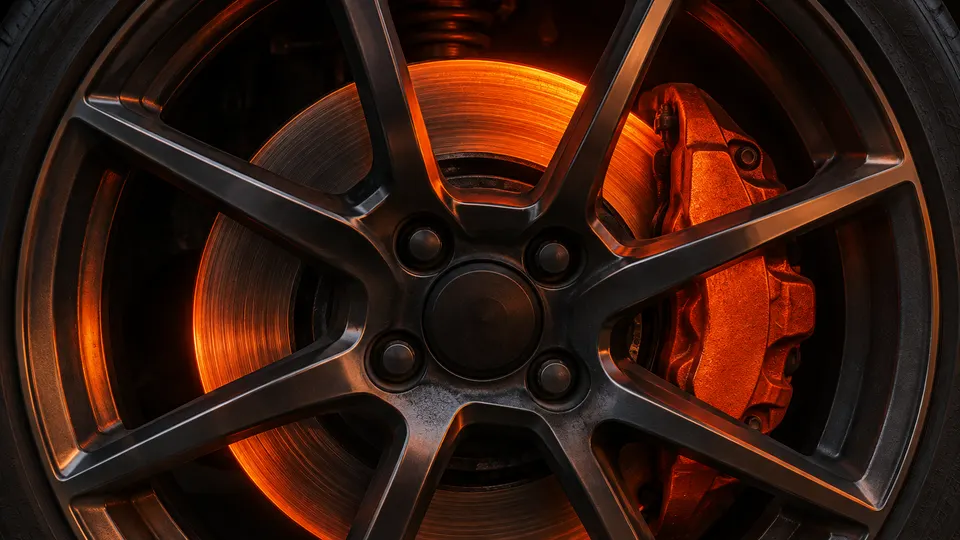
Uneven rotor thickness. Rotors are often described as "warped," but the usual problem is thickness variation: some spots on the rotor face are slightly thicker than others. Know Your Parts, a technical resource from brake parts makers, says only about 10 to 20 microns of thickness variation is enough for a driver to notice. It also explains how side-to-side wobble of the rotor (runout) lets the pads touch only the high spots during normal driving, which slowly wears the rotor unevenly [2].
A rotor does not need to look damaged to cause a shake. A difference thinner than a human hair can be felt through the pedal.
Uneven pad wear. Pads that wear unevenly make weak, inconsistent contact with the rotor, which can cause shaking [1].
A sticking caliper. If a caliper does not release fully, one wheel keeps dragging. That creates uneven grip and heat [1], and it can overheat the rotor.
Tires and wheel balance. Tires that are out of balance or worn unevenly can produce a similar shake, and wheels can drift out of balance over time [1]. Braking shifts weight to the front, which can make a tire problem more noticeable.
Suspension and steering parts. Worn control arm bushings, struts, tie rods or ball joints let the wheel move when braking forces load it. Mavis calls alignment and suspension problems a major safety concern.
Wheel installation. Lug nuts tightened unevenly, or by guesswork instead of to the specified torque, can distort how the rotor sits. If the shake started soon after a tire change or brake job, mention that to the shop.
Where do you feel the shake: steering wheel, pedal or seat?
Where the vibration shows up is the best free clue you have. Mavis's brake guide puts it simply: a shaking steering wheel generally means the problem is at the front of the car, while shaking you feel in the seat generally points to the rear rotors or rear tires. A pulsing brake pedal is linked to uneven rotor wear or a caliper problem [1].
Also notice when it happens. A shake only during braking points to the brakes. A shake at a certain speed whether or not you brake points more to tires, balance or suspension. A shake at idle or under acceleration is usually an engine problem, such as a misfire; see rough idle and P0300.
Is it safe to drive when your car shakes when braking?
Not for long. Mavis says plainly that it is not safe to drive a vehicle that shakes when braking, because vibration under braking can mean reduced stopping power and a longer stopping distance [1]. How urgent it is depends on the signs:
- Mild pulsation only in hard or high-speed stops, brakes otherwise normal: book a brake inspection within days. Leave extra following distance and avoid heavy loads or towing.
- Strong shaking, pulling to one side, grinding or scraping, a burning smell, or smoke from a wheel: stop driving and have the car towed or inspected where it is.
- Pedal goes soft or sinks toward the floor: this is a brake failure warning. Pull over as soon as it is safe and do not keep driving.
The California Driver's Handbook tells drivers whose brake pedal sinks to the floor to pump the brakes, shift to a lower gear, and use the parking brake to stop [3]. That is an emergency procedure, not a way to keep driving.
If the pedal sinks, the car pulls hard, or a wheel smells hot, stop driving. Brakes are not a fix-it-later system.
One normal case: in a hard stop on a slippery road, cars with antilock brakes (ABS) can make the pedal pulse and buzz as the system works. That is expected. A pulse in ordinary, gentle stops on dry pavement is not.
How can you narrow down the cause safely?
Do only checks that need no tools under the car, with the car parked on level ground, in Park, with the parking brake set and the engine off.
- Note where and when you feel it: steering wheel, pedal or seat; braking only, or at a certain speed.
- Check tire pressures against the placard in the driver's door jamb.
- Look at the tires for bulges, flat spots, or wear on one edge.
- Look through the wheel spokes at the rotor face if you can see it. Deep grooves, a blue tint, or a heavy rust ridge are worth reporting.
- Notice smells and noise after a drive: a hot or burning smell from one wheel can mean a dragging caliper. Do not touch the wheel; it can be very hot.
- Think about recent work. A tire change, rotation or brake job shortly before the shake started is an important clue.
Anything beyond looking, such as removing wheels, measuring rotors, or working on calipers and brake lines, is a job for a qualified technician. Brakes are a safety system, and the technical guidance from parts makers stresses extra care during brake repairs [2].
Will a shaking brake set a check engine light or a code?
Usually not. Rotors, pads and tires have no sensor that sets a check engine light. If a warning light does come on with the shake, it is more likely the ABS or brake light, and the code behind it will usually be a C code. Haynes' code reference explains that codes starting with C belong to the chassis systems, while P codes are powertrain [4]. Many basic readers only read P codes from the engine computer, so an ABS code may need a scan tool that reads the brake module. Our OBD2 scanner guide explains the difference, and the code lookup tool explains any code you find.
If the check engine light is flashing and the car shakes, the cause is more likely an engine misfire than the brakes. Read our flashing check engine light guide and browse the trouble codes index.
What does the fix usually involve?
The repair follows the cause:
| Cause | Typical repair |
|---|---|
| Uneven rotor thickness | Resurface or replace rotors, usually with new pads; check runout on the hub |
| Uneven pad wear | Replace pads and find why they wore unevenly |
| Sticking caliper | Service or replace the caliper, often with pads and rotor on that axle |
| Tire balance or wear | Balance, rotate or replace tires |
| Worn suspension or steering parts | Replace worn parts, then align the wheels |
We do not give prices, because we found no reliable source with U.S. brake repair costs as of November 2026. What drives the cost: whether only pads and rotors are needed or calipers too, front versus rear axle, the size and type of rotor your vehicle uses, and local labor rates. Ask for the measurements the shop took, so you know why parts were replaced. A dealer can also check your VIN for open recalls; our VIN decoder confirms the exact model first.
Frequently Asked Questions
Are my rotors warped if the car shakes when braking?
Probably not literally bent. Brake parts makers explain that the usual problem is small variations in rotor thickness, often started by runout, which cause the pads to grab and release. The fix is still the rotors, but the diagnosis matters because it also checks why the variation started.
Why does my car shake when braking at high speed only?
Small rotor thickness differences are felt most when the rotor spins fast and braking forces are high. Highway-speed shaking during braking usually still points to the front rotors. If it shakes at that speed without braking, have the tires and balance checked.
Can new brakes cause shaking?
Yes. If the shake started soon after a brake job or tire change, the cause can be lug nuts tightened unevenly, rust left on the hub face, or a rotor not seated flat. Return to the shop that did the work and describe when it started.
Is it normal for the pedal to pulse in an emergency stop?
Yes, on cars with antilock brakes. The ABS pulses the brakes to keep the wheels from locking, and you can feel it in the pedal. Keep firm pressure on the pedal and steer. Pulsing in normal, gentle stops is not ABS and should be inspected.
Our Take
We treat shaking under braking as a safety issue, not a comfort issue. The sources agree that the usual cause is uneven rotor thickness, and that the brakes may not stop the car as well as they should. Our advice is to note where you feel the shake and when, check your tires, and get the brakes inspected within days. If the pedal sinks, the car pulls hard, or a wheel smells hot, we would stop driving and have it towed. Brake measurement and repair belong to a qualified technician.
Sources
- Why Does My Car Shake When I Press My Brakes?. Mavis Tires and Brakes, 2025.
- Pedal Pulsation and Vibration Diagnostic Tips. Know Your Parts, 2026.
- California Driver's Handbook: Safe Driving. California Department of Motor Vehicles, 2026.
- OBD2 Codes List: Your Go-To Reference. Haynes, 2026.
This is general information to help you understand your vehicle, not a substitute for a hands-on diagnosis. If a warning light is flashing or the car runs badly, stop driving and have it checked by a qualified technician. Spotted an error? Tell us.
Keep Reading
Why Is My Engine Idling Rough?
A rough idle usually comes from a misfire, a vacuum leak, a dirty throttle body or worn engine mounts. See the clues, related codes and what to check first.

Why Is My Car Hard to Start?
A hard-starting car usually has a weak battery, a fuel delivery problem, worn spark parts, or a sensor fault. Learn how to narrow it down, cheap checks first.