How Do You Use an OBD2 Scanner? A Step-by-Step Guide
Quick Answer
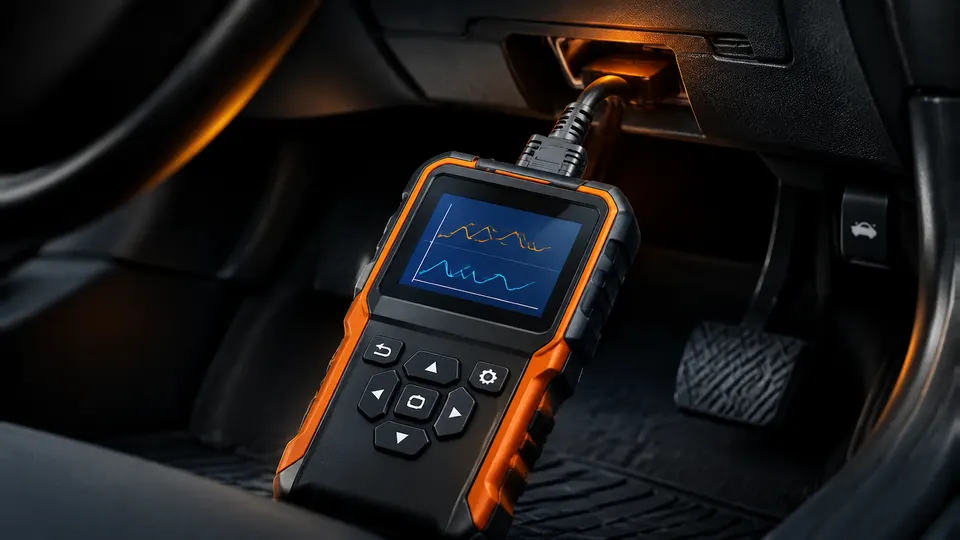
To use an OBD2 scanner, find the 16-pin port under the dashboard on the driver's side, plug the scanner in with the ignition off, then turn the key to On (or start the engine) and choose "Read Codes." Write down every code and the freeze frame data before doing anything else. A code tells you where to look, not which part to buy.
On this page
Key Takeaways
- Every gasoline car and light truck sold in the U.S. since 1996 has an OBD-II port, usually under the dash near the steering column.
- Read the codes, then save the freeze frame data. It shows the conditions when the fault happened.
- A code points to a system or a symptom. Diagnose before buying parts.
- Clearing codes does not fix anything and resets readiness monitors, which emissions inspections check.
- A flashing check engine light means stop reading and start acting: reduce speed and get the car checked.
What does an OBD2 scanner actually do?
OBD-II (on-board diagnostics, second generation) is a self-check system built into every light-duty vehicle from model year 1996 on. Arizona's emissions program describes it as a computer that monitors emissions-related functions and turns on the check engine light when it finds a problem [1]. The light may read "Check Engine" or "Service Engine Soon."
A scanner is a window into that computer. Depending on the tool, it can show:
- Trouble codes: stored, pending and permanent codes, such as P0420.
- Freeze frame data: a snapshot of sensor values at the moment a code set.
- Live data: sensor readings in real time, such as coolant temperature, engine speed and fuel trims.
- Readiness monitors: whether the car has finished its self-tests since codes were last cleared.
A basic code reader may only do the first one, and often only for the engine computer. A scanner that shows live data and freeze frame is more useful for diagnosis. Some codes, such as P0700, only point you to another computer, like the transmission module, that a basic reader cannot open.
What a scanner cannot do is tell you which part failed. The U.S. Department of Energy's fuel economy site says a lit check engine light means something is wrong and suggests having a mechanic check the car [3]. The scanner tells you where that mechanic, or you, should start looking.
Where is the OBD2 port in your car?
On almost every car the port, called the data link connector, is inside the cabin. Georgia's emissions program says it is usually on or near the dashboard, under the dash and not under the hood [2]. Look:
- Under the dashboard on the driver's side, near the steering column or above the pedals.
- Behind a small cover or panel in the lower dash.
- Near the center console, on some models.
It is a 16-pin, D-shaped plug. If you cannot find it, the owner's manual shows the location. Our VIN decoder confirms the exact model and year if you are unsure which manual applies.
How do you read codes step by step?
Park somewhere safe, set the parking brake, and keep the engine off while you connect.
- Turn the ignition off and plug the scanner firmly into the port. A wireless adapter plugs in the same way and pairs with a phone app.
- Turn the ignition to On without starting, or start the engine if your tool's instructions say so. Do not run the engine in a closed garage.
- Let the tool connect. Enter the VIN or select make, model and year if asked.
- Choose "Read Codes" or "Diagnostic Trouble Codes." Note stored, pending and permanent codes separately.
- Open freeze frame data for each code and save it, photograph it, or write it down.
- Check readiness monitors if your tool shows them.
- Look up each code. Our code lookup tool explains what it means, how serious it is, and the usual causes.
Write everything down before you clear anything. Once codes are cleared, the freeze frame data is gone.
What do the codes, freeze frame and live data tell you?
Every code has five characters. Haynes' code reference explains the first letter: P for powertrain (engine and transmission), C for chassis, B for body and U for network communication, with the numbers after it giving more detail [4]. Under the SAE J2012 standard, a second character of 0 means a generic code with the same meaning on every make, and 1 usually means a manufacturer-specific code.
Some common examples and what they point to:
| Code | Plain meaning | First thing to check |
|---|---|---|
| P0420 | Catalytic converter efficiency below threshold | Exhaust leaks, oxygen sensor data |
| P0171 | Engine running lean | Vacuum leaks, intake air leaks |
| P0300 | Random or multiple misfires | Spark plugs, coils, how the engine runs |
| P0456 | Very small evaporative system leak | Gas cap seal and fit |
Your tool may sort codes into three lists. Pending codes mean the computer saw a fault once but has not confirmed it yet, so the light may still be off. Stored (or confirmed) codes are the ones that turned the light on. Permanent codes cannot be erased with a scan tool; the car clears them itself after the repair works and the monitor passes again. A pending code is an early warning worth noting, especially if a stored code follows a few days later.
Freeze frame shows the conditions when the code set: engine speed, vehicle speed, coolant temperature, load and fuel trims. It tells you whether the fault happened cold or hot, at idle or on the highway.
Live data lets you watch sensors in real time. Fuel trims, coolant temperature and oxygen sensor readings are the most useful for beginners. Compare them with the freeze frame values.
Should you clear the codes after scanning?
Only after a repair, and know what clearing does. Clearing does not fix anything. It turns the light off, erases freeze frame data, and resets the readiness monitors to "not ready." If the fault is still there, the light comes back.
Readiness matters at inspection time. Georgia's program says a car with the check engine light on will not pass, and that clearing codes with a scan tool or disconnecting the battery can leave monitors "not ready," which also fails the test [2]. Arizona rejects 2001 and newer vehicles with more than one monitor not ready [1].
To set the monitors again after a real repair, drive normally. Georgia's guidance describes a cold start after about eight hours parked, a fuel level between a quarter and three quarters of a tank, and one to two weeks of normal driving including some highway miles [2]. Your owner's manual may describe the exact drive cycle.
Clearing a code hides the evidence. It does not remove the problem, and the inspection station will see "not ready."
When should you stop scanning and see a mechanic?
A scanner is a starting point. Hand the car to a qualified technician when:
- The check engine light is flashing. That usually means a severe misfire. Reduce speed and get it checked right away; see our flashing check engine light guide.
- The car drives badly: stalling, shaking, slipping gears, overheating or a burning smell.
- The code involves the transmission, airbags, ABS or high-pressure fuel parts. These need proper tools and procedures.
- The same code returns after your simple checks, such as a gas cap or a vacuum hose.
Browse all codes on our trouble codes index to see which are Safe to Drive, Fix Soon or Stop Driving.
Frequently Asked Questions
Can I use an OBD2 scanner while driving?
Plugging in a wireless adapter and reading data while someone else drives is possible, but the driver should never look at a screen. Read codes while parked. If you want live data on the road, have a passenger watch it.
Do I need the engine running to read codes?
Usually not. Most tools read codes with the ignition on and the engine off. Live data such as fuel trims and oxygen sensor readings needs the engine running. Follow your tool's instructions.
Will an OBD2 scanner work on my car?
If it is a gasoline car or light truck sold in the U.S. from model year 1996 on, it has an OBD-II port, as Arizona's program notes for 1996 and newer light-duty vehicles. Enhanced functions, such as transmission or airbag codes, depend on the tool and the make.
Why does my scanner show no codes when the light is on?
The code may be stored in a different module the tool cannot reach, or the connection may not be complete. Check that the ignition is on, the plug is fully seated, and the tool supports your make. A shop scan tool can read every module.
What is the difference between a code reader and a scan tool?
A code reader shows and clears engine codes, and that is about all. A scan tool adds freeze frame, live data, readiness status and often access to other modules such as the transmission or brakes. For diagnosing anything beyond a loose gas cap, the extra data matters more than the code itself.
Our Take
We think every driver who owns a car built since 1996 benefits from knowing how to read their own codes. It turns a vague warning light into something you can look up and discuss with a mechanic. But the code is the start of a diagnosis, not the end. The state inspection programs we cite are clear that clearing codes or disconnecting the battery only creates a "not ready" car. Our advice: read, record, look up, check the simple things, and let a technician handle anything involving safety systems, the transmission or a flashing light.
Sources
- OBD. Arizona Department of Environmental Quality, myAZcar.com, 2021.
- Learn About OBD Testing. Georgia's Clean Air Force, 2026.
- Gas Mileage Tips: Keeping Your Vehicle in Shape. U.S. Department of Energy, FuelEconomy.gov, 2026.
- OBD2 Codes List: Your Go-To Reference. Haynes, 2026.
This is general information to help you understand your vehicle, not a substitute for a hands-on diagnosis. If a warning light is flashing or the car runs badly, stop driving and have it checked by a qualified technician. Spotted an error? Tell us.
Keep Reading
Why Is My Check Engine Light Flashing?
A flashing check engine light usually means a severe misfire that can overheat the catalytic converter. Here is what it means, what to do now and what to check.