P0171 Code: System Too Lean (Bank 1)
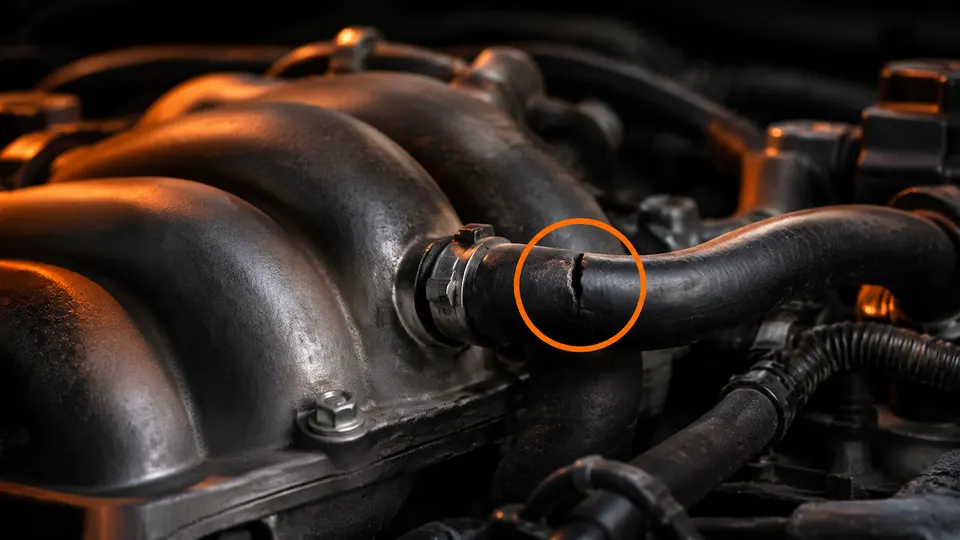
Quick Answer
P0171 means your engine computer sees too much air or too little fuel on bank 1 and has reached the limit of how much fuel it can add to correct it. The car is usually still drivable, but you should get it checked soon. The most common cause is unmetered air from a vacuum or intake leak, followed by a dirty mass airflow (MAF) sensor and low fuel pressure.
On this page
Key Takeaways
- P0171 is a "fix soon" code: you can usually drive, but stop and get help if the check engine light starts flashing.
- A lean code points to a system, not a part. Air leaks, a dirty MAF sensor and weak fuel delivery cause it far more often than a bad oxygen sensor.
- Start with a scanner: read freeze frame data and fuel trims before buying anything.
- The cheapest checks come first: intake boot, vacuum hoses, PCV hoses, oil cap and dipstick seal.
- Clearing the code does not fix the cause, and a recently cleared car may not pass an emissions inspection.
P0171 at a glance
- Meaning
- System Too Lean (Bank 1)
- System
- Fuel & Air
- Severity
- Fix Soon The car usually still drives, but a lean mixture can cause hesitation, misfires and overheated parts, so get it diagnosed soon and stop if the check engine light starts flashing.
- Common causes
- Vacuum or intake air leak after the MAF sensor
- Dirty or failing mass airflow (MAF) sensor
- Weak fuel pump or clogged fuel filter (low fuel pressure)
- Restricted or leaking fuel injector
- Faulty upstream oxygen sensor
- Applies to
- Generic OBD-II code: same meaning on all 1996 and newer cars and light trucks sold in the U.S.
What does P0171 mean?
P0171 means the engine is running lean on bank 1. "Lean" means the air and fuel mixture has more air than the computer wants, and "bank 1" is the side of the engine that holds cylinder 1. On a four-cylinder engine there is only one bank, so P0171 covers the whole engine.
The engine computer, often called the PCM or ECM, constantly fine-tunes the mixture. It measures incoming air with the MAF sensor (or a manifold pressure sensor on some engines), then reads the exhaust with the upstream oxygen sensor. If the oxygen sensor reports a lean exhaust, the computer adds fuel. These corrections are called fuel trims. When the computer has added as much fuel as it is allowed and the exhaust still reads lean, it stores P0171 and turns on the check engine light.
ALLDATA DIY puts it simply: P0171 indicates too much air, not enough fuel, or both [1]. The oxygen sensor that reports the lean condition is usually the messenger, not the culprit.
Is it safe to drive with P0171?
Usually yes, for a short time, but treat P0171 as "fix soon." Most cars with this code still start and drive, and you may notice nothing at all. Others show a rough or hunting idle, hesitation when you press the gas, or weak power under load. Carista lists rough idle, possible stalling, hesitation, reduced power and idle misfires as typical symptoms [2].
The risk grows the longer you ignore it. A lean mixture burns hotter and can lead to misfires. The California Air Resources Board says most manufacturers advise service as soon as conveniently possible when the light comes on, and that continued driving can damage other parts [3].
If the check engine light starts flashing, or the engine shakes and stumbles, pull over when it is safe and stop driving. A flashing light means a misfire is happening that could damage the catalytic converter, according to the same CARB fact sheet. If P0171 shows up with misfire codes like P0300, read our guide to a flashing check engine light before you drive any farther.
What causes P0171?
P0171 almost always comes down to one of three things: extra air the computer did not measure, too little fuel, or a sensor that gives the computer the wrong picture. Here are the usual suspects, most common first.
- Vacuum or intake air leak after the MAF sensor. A cracked intake boot, a split vacuum hose, a torn PCV hose or valve, or a leaking intake manifold gasket. ALLDATA DIY and Carista both list vacuum leaks first [1].
- Dirty or failing MAF sensor. If the sensor under-reports airflow, the computer injects too little fuel.
- Low fuel pressure. A weak fuel pump or a clogged fuel filter starves the engine, often worst under load or at high speed.
- Restricted or leaking fuel injector. A clogged injector on bank 1 delivers less fuel than commanded.
- Faulty upstream oxygen sensor. Possible, but less common than people think.
- Exhaust leak ahead of the oxygen sensor. Outside air pulled in near the sensor can make the exhaust look leaner than it is.
| Cause | Typical clue | Cheapest first step |
|---|---|---|
| Vacuum or intake leak | Worse at idle, hissing sound, high trims at idle that drop at higher rpm | Look and listen around hoses and the intake boot |
| Dirty MAF sensor | Lean at idle and under load, may set with airflow codes such as P0101 | Inspect the air filter and sensor, clean with MAF-safe cleaner |
| Low fuel pressure | Hesitation under load, worse uphill or at highway speed | Have fuel pressure tested |
| Injector problem | Often with a misfire on one cylinder | Scanner data, then a technician test |
| O2 sensor | Slow or stuck readings in live data | Check it last |
If your engine has two banks and both P0171 and P0174 are set, look for something both sides share, such as a MAF sensor, fuel pressure, or a large intake leak. P0171 alone on a V6 or V8 points more toward something on bank 1 only.
How do you diagnose P0171?
Work from cheap and safe to expensive. You need a scanner that shows freeze frame and live data; our guide on how to use an OBD2 scanner covers the basics.
- Read every code and the freeze frame. Write down engine speed, load, coolant temperature and fuel trims at the moment P0171 set. A lean code that set at idle points toward a vacuum leak. One that set at highway speed points toward fuel delivery.
- Check fuel trims in live data. Positive numbers mean the computer is adding fuel. Carista notes that short and long term trims above +10% help confirm a real lean condition [2]. Compare trims at idle and at about 2,500 rpm. If they fall back toward zero at higher rpm, suspect a vacuum leak.
- Do a visual check with the engine off. Look at the rubber intake boot between the air filter box and the throttle body, especially the folds underneath. Check vacuum and PCV hoses for cracks or loose ends. Make sure the oil filler cap is tight and the dipstick is fully seated, since both seal the crankcase.
- Listen with the engine idling. A hiss or whistle often gives away a leak. Keep hands, hair and clothing away from belts and the fan.
- Inspect the MAF sensor and air filter. A soaked or very dirty filter, or debris on the sensor, can skew airflow readings.
- Smoke test and fuel pressure test. A shop smoke test finds leaks you cannot see. Fuel pressure testing involves a pressurized fuel system, so have a qualified technician do it.
- Look at the oxygen sensor last. ALLDATA DIY warns that replacing the oxygen sensor first is a common mistake, because the sensor is often just reporting a real lean condition.
How do you fix P0171, and what does it cost?
The fix is whatever the diagnosis found, so the cost depends entirely on the cause. A loose hose clamp or a reseated oil cap costs nothing. A cracked intake boot or vacuum hose is usually an inexpensive part. Cleaning a MAF sensor with the right cleaner is a cheap do-it-yourself job, but replacing the sensor costs more. Fuel pump and intake manifold gasket jobs sit at the high end because of parts and labor time.
We have not found a reliable U.S. repair cost survey for P0171 as of November 2026, so we do not quote a dollar range. These things drive the bill:
- What failed: a hose or boot versus a fuel pump or intake gasket.
- Engine layout: parts buried under the intake manifold or inside the fuel tank take more labor.
- Diagnostic time: shops often charge for a smoke test or fuel pressure test before any repair.
- Warranty: emissions parts may be covered by the federal emissions warranty, and some makers have issued service bulletins for lean codes.
After the repair, clear the code with your scanner and drive normally. Clearing does not fix anything; if the cause is still there, P0171 comes back. Also know that clearing codes or disconnecting the battery resets the readiness monitors. California now requires all readiness monitors to be set to pass a Smog Check, and monitors complete through normal driving or a specified drive cycle [4]. Fix the cause first, then let the car finish its self-tests before any inspection.
Which vehicles get P0171 most often?
Any gasoline car can set P0171, but some engines have known, documented patterns. On several GM 1.4L turbo models, including the Chevrolet Cruze, Sonic and Trax, GM bulletin 19-NA-114 links P0171 to a torn PCV diaphragm in the camshaft cover [5]. See our P0171 on Chevrolet page.
Toyota bulletin T-SB-0166-19 covers flex-fuel 5.7L Tundra and Sequoia trucks that set lean or rich codes [6]. Our P0171 on Toyota page explains it. If you see the opposite code, read about P0172, system too rich.
Frequently Asked Questions
Can a bad oxygen sensor cause P0171?
It can, but it is not the most likely cause. The upstream oxygen sensor usually reports a lean condition that really exists. ALLDATA DIY warns against replacing it first [1]. Rule out air leaks, the MAF sensor and fuel pressure before you buy a sensor.
Can a loose gas cap cause P0171?
A loose gas cap normally sets an evaporative system (EVAP) code such as P0455, not a lean code. It costs nothing to check the cap, but do not expect it to fix P0171. A loose oil filler cap or a dipstick that is not fully seated is a more likely cheap culprit, because it lets air into the crankcase.
Will P0171 go away on its own?
The light may go out if the computer stops seeing the lean condition over later drives, but the cause is usually still there. A small vacuum leak tends to grow. Treat a light that went out as a reminder to check, not as a fix.
Can P0171 damage my engine?
Driving a short time with a mild lean code is unlikely to cause harm. Running lean for a long time can cause misfires and extra heat, and the California Air Resources Board notes that continued driving with a fault can damage other parts [3].
Our Take
We think P0171 is one of the most over-repaired codes, because the oxygen sensor gets blamed for a problem it only reports. Based on the repair guidance we reviewed, the smart order is scanner first, eyes second, wallet last. Freeze frame and fuel trim data cost nothing if you own a basic scanner, and they tell you whether to hunt for a vacuum leak or a fuel problem. A cracked intake boot or loose PCV hose is a common and cheap find. If the visual checks come up empty, we would pay for a smoke test and a fuel pressure test before replacing parts by guesswork. And if your vehicle has a manufacturer bulletin for lean codes, ask a dealer to check your VIN, because the fix may be covered.
Sources
- What Common OBD-II Codes Really Mean. ALLDATA DIY, 2026.
- P0171 Code: Fuel Trim System Too Lean (Bank 1). Carista, 2026.
- On-Board Diagnostic II (OBD II) Systems Fact Sheet. California Air Resources Board, 2019.
- New OBD readiness monitor regulations explained. California Bureau of Automotive Repair, 2025.
- Bulletin 19-NA-114: Malfunction Indicator Lamp Illuminated, DTC P0171 Set. General Motors via NHTSA, 2019.
- T-SB-0166-19: Extended Crank and/or MIL ON With DTC P0171, P0174, P0172, P0175, P1604 (Flex-Fuel). Toyota via NHTSA, 2019.
This is general information to help you understand your vehicle, not a substitute for a hands-on diagnosis. If a warning light is flashing or the car runs badly, stop driving and have it checked by a qualified technician. Spotted an error? Tell us.
Keep Reading
P0174 Code: System Too Lean (Bank 2)
P0174 means bank 2 of a V6 or V8 is running lean. See if it is safe to drive, why it often appears with P0171, and which cheap checks to do before parts.
P0172 Code: System Too Rich (Bank 1)
P0172 means bank 1 is running rich: too much fuel or too little air. Learn if it is safe to drive, the usual causes, and the cheap checks to do before parts.
P0171 on Toyota: Common Causes and Fixes
P0171 on a Toyota: what the code means, the Toyota bulletin for flex-fuel 5.7L Tundra and Sequoia trucks, whether it is safe to drive, and checks to do first.
P0171 on Chevy: Causes, GM Bulletins and Fixes
P0171 on a Chevy: what it means, the GM bulletin on torn PCV diaphragms in 1.4L turbo Cruze, Sonic and Trax engines, if it is safe to drive, and what to check.
P0300 Code: Random/Multiple Cylinder Misfire Detected
P0300 means the engine is misfiring in more than one cylinder. Learn what a flashing light means, when to stop driving, common causes and checks to do first.
How Do You Use an OBD2 Scanner? A Step-by-Step Guide
Learn how to use an OBD2 scanner: find the port, read trouble codes, freeze frame and live data, and know when clearing a code is a bad idea before a smog test.