P0420 Code: Catalytic Converter Efficiency Below Threshold
Quick Answer
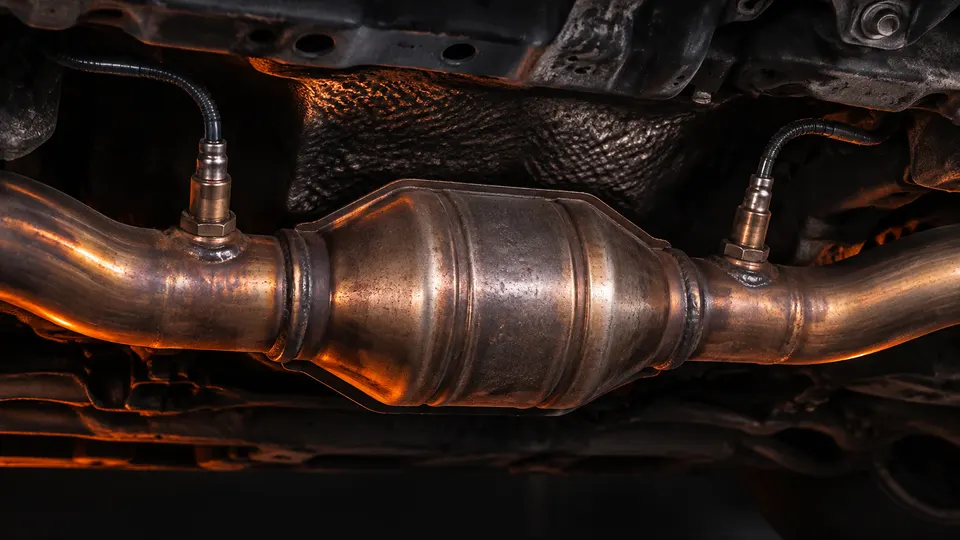
P0420 means your engine computer thinks the Bank 1 catalytic converter is no longer cleaning the exhaust as well as it should. It is usually safe to drive in the short term because the car normally runs the same, but get it checked soon. The converter is often worn, yet a faulty rear oxygen sensor, an exhaust leak or an engine problem can set the same code.
On this page
Key Takeaways
- P0420 is a Bank 1 catalytic converter efficiency code. It does not prove the converter itself has failed.
- It is usually safe to drive for now, but a flashing check engine light means a misfire: pull over and stop driving hard.
- Fix misfires, fuel mixture problems and exhaust leaks before you pay for a converter.
- Federal rules give catalytic converters an 8-year or 80,000-mile emissions warranty on light-duty vehicles.
- The code will keep your car from passing an emissions inspection until it is properly repaired.
P0420 at a glance
- Meaning
- Catalyst System Efficiency Below Threshold (Bank 1)
- System
- Emissions & Catalyst
- Severity
- Safe to Drive Usually safe to drive in the short term because it rarely affects how the car runs, but still get it checked soon and watch for a flashing light.
- Common causes
- Worn-out or damaged catalytic converter
- Faulty downstream (rear) oxygen sensor
- Exhaust leak near the oxygen sensors
- Engine misfire or rich/lean running that damaged the converter
- Engine burning oil or coolant
- Applies to
- Generic OBD-II code: same meaning on all 1996 and newer cars and light trucks sold in the U.S.
What does P0420 mean?
P0420 stands for "Catalyst System Efficiency Below Threshold (Bank 1)." Your powertrain control module (PCM) compares the oxygen sensor in front of the catalytic converter with the one behind it. A healthy converter stores and uses oxygen, so the two signals look very different. When they stop looking different enough, the PCM decides the converter is below its programmed limit and turns on the check engine light [2].
"Bank 1" is the side of the engine that holds cylinder 1. A four-cylinder engine has only Bank 1. A V6 or V8 has two banks, and the matching code for the other side is P0430.
Most drivers notice nothing except the light. The car starts, idles and accelerates the same, because the converter test is a borderline pass or fail check, not a running problem. If you also notice weak acceleration, a rattle from under the car or a strong sulfur smell, the converter may be badly clogged or broken inside, and the car should be checked sooner rather than later.
P0420 tells you the converter test failed, not why it failed. ALLDATA DIY puts it plainly: the code means the converter is not cleaning the exhaust as efficiently as expected, which does not necessarily mean the converter is dead [1].
Is it safe to drive with P0420?
Yes, in most cases P0420 is safe to drive in the short term. The code rarely changes how the car runs, so you can usually drive to work or to a shop. Do not ignore it for months, though. A converter that keeps failing can hide a problem that is still getting worse, and the light being on means you will not notice a second fault.
Watch the light closely. If the check engine light starts flashing, or the engine shakes and stumbles, pull over and stop driving. A flashing light means an active misfire. Unburned fuel then reaches the converter and can overheat it, which turns a sensor problem into a converter replacement. See our guide on a flashing check engine light and the P0300 misfire code.
Also plan around inspections. California's Bureau of Automotive Repair says a vehicle will not pass a Smog Check with the check engine light on [4]. Many other state programs also read the OBD system.
What causes P0420?
The most common causes, roughly in the order shops check them:
- Worn or damaged catalytic converter. Converters lose efficiency with age, heat and contamination.
- Faulty downstream oxygen sensor. A lazy or failing rear sensor can make a good converter look bad.
- Exhaust leak near the sensors. A cracked manifold, bad gasket or leaking flex pipe lets outside air in and skews the oxygen readings.
- Engine running rich, lean or misfiring. Leaking injectors, high fuel pressure, spark plug or coil faults, and a bad coolant temperature sensor or thermostat are all on Identifix's list [2].
- Engine burning oil or coolant. These coat the converter and slowly kill it.
- Outdated PCM software. Some manufacturers have issued updates because the software misread a healthy converter.
Technicians have a saying that ALLDATA DIY repeats: catalytic converters don't die, they're murdered. In other words, the converter often fails because something upstream was left unrepaired [1]. Fuel mixture codes such as P0171 and P0172 are common partners.
How do you diagnose P0420?
Start with the cheap checks and work toward the expensive part. A scanner that shows live data and freeze frame does most of the early work; our guide on how to use an OBD2 scanner covers the basics, and the code lookup tool explains any other codes you find.
- Read every code and the freeze frame. If you also have misfire, lean or rich codes, repair those first. P0420 often comes back when they are ignored.
- Check fuel trims and oxygen sensor live data. Identifix recommends reviewing freeze frame data and short and long term fuel trims before anything else. On a warm engine, a rear sensor that switches up and down like the front one points toward a weak converter [2].
- Look for exhaust leaks with the engine cold. Black soot marks, a ticking sound at startup and broken hangers are clues. A shop can smoke test the exhaust.
- Confirm the rear sensor works. A technician will force the mixture rich and lean and watch the sensor respond.
- Check service bulletins, software and warranty. Ask a dealer to check your VIN for PCM updates and open recalls.
- Verify the converter. Back pressure and inlet versus outlet temperature checks help confirm a clogged or dead converter.
Freeze frame is worth a careful look. It records conditions such as engine speed, load, coolant temperature and fuel trims at the moment the code set. If the engine was still cold, or the fuel trims were far from normal, the converter may simply be reacting to another problem. Write those values down or save a screenshot before anyone clears the code.
Steps 1 to 3 are reasonable driveway checks. Leave anything under a running engine, on a lift or near a hot exhaust to a qualified technician.
How do you fix P0420, and what does it cost?
The fix is whatever the diagnosis found. That may be an exhaust gasket, an oxygen sensor, a misfire repair, a software update or a new converter. Replacing the converter without fixing the cause is the most expensive way to see P0420 come back.
As of November 2026, Identifix's guide cites RepairPal averages of $454 to $550 for an oxygen sensor replacement and $2,301 to $2,473 for a catalytic converter replacement [2]. Your price depends on the vehicle, how many converters it has, labor time, whether the converter is part of the exhaust manifold, and whether your state requires a specific type of replacement converter.
Check the warranty before you pay. Federal rules set an 8-year or 80,000-mile warranty period, whichever comes first, for catalytic converters on light-duty vehicles, light-duty trucks and medium-duty passenger vehicles [3].
After the repair, a shop may clear the code. Clearing does not fix anything. The PCM has to rerun its catalyst test during normal driving, and inspection stations check that the readiness monitors have finished. California's BAR suggests driving for a week or two after repairs so the monitors can reset [4].
Never consider removing or disabling emissions equipment. Tampering with a vehicle's emissions control system is illegal under the Clean Air Act, and EPA treats the OBD system itself as a protected monitoring device [5].
Do some vehicles have known P0420 bulletins?
Yes. Some manufacturers have admitted that software, not the converter, set the code on certain models. Honda extended the warranty to 10 years or 150,000 miles on some 2016 to 2017 Pilot, 2017 Ridgeline and 2018 Odyssey models for P0420 or P0430 repairs, which can include a software update and fuel injectors [6]. Ford issued Emission Recall 24E04 for certain 2022 to 2023 F-150 Hybrid trucks because the OBD system may falsely set P0420 or P0430 [7].
Read our make pages for details: P0420 on Honda and P0420 on Nissan.
Frequently Asked Questions
Can a bad oxygen sensor cause P0420?
Yes. A slow or failing downstream oxygen sensor can make a healthy converter look weak. That is why a shop tests the rear sensor's response before replacing the converter.
Will P0420 go away on its own?
Sometimes the light goes off if the PCM's catalyst test passes on later drives, but the stored history remains and the cause is usually still there. If the code returns, it needs a real diagnosis.
Is P0420 covered by warranty?
Often, if your vehicle is within 8 years or 80,000 miles and the converter has failed. That federal period applies to catalytic converters on light-duty vehicles [3]. Some makers have also extended coverage for specific models.
Should I clear the code to see if it comes back?
Not before you save the freeze frame data. Clearing erases that snapshot, turns the light off without repairing anything and resets the readiness monitors, so the car is not ready for an inspection until it finishes its self tests again. Clear it after a repair, not instead of one.
What is the difference between P0420 and P0430?
They are the same test on different sides of the engine. P0420 is Bank 1, the side with cylinder 1. P0430 is Bank 2 on V6 and V8 engines.
Our Take
We think P0420 is the code where patience saves the most money. The sources agree that the converter test only tells you the converter looks weak, and that misfires, fuel mixture problems, leaks and lazy sensors can produce the same result. So we would read every code, look at live data and check for leaks before pricing a converter. We would also ask a dealer to run the VIN for bulletins and recalls, because Honda and Ford have both fixed some P0420 cases with software. Keep driving gently if the car runs normally, but treat a flashing light as a reason to stop. And never let anyone talk you into disabling emissions parts.
Sources
- What Common OBD-II Codes Really Mean. ALLDATA DIY, 2026.
- P0420 Code: The Guide to Diagnosis and Fast Fixes. Identifix, 2025.
- 40 CFR 85.2103, Emission performance warranty. Cornell Law School Legal Information Institute, 2026.
- Smog Check. California Bureau of Automotive Repair, 2026.
- Tampering and Aftermarket Defeat Devices. U.S. Environmental Protection Agency (Clean Air Northeast), 2026.
- Warranty Extension: MIL Comes On with DTC P0420/P0430, P030x, and/or P219A/B. American Honda Motor Co., Inc. (via NHTSA), 2021.
- Emission Recall 24E04. Ford Motor Company (via NHTSA), 2024.
This is general information to help you understand your vehicle, not a substitute for a hands-on diagnosis. If a warning light is flashing or the car runs badly, stop driving and have it checked by a qualified technician. Spotted an error? Tell us.
Keep Reading
P0420 on Nissan: Campaigns, Sensor Names and What to Check
P0420 on a Nissan: the Sentra SULEV emission campaign, how Nissan names its A/F and rear O2 sensors, what to check first, and when a dealer visit is free.
P0430 Code: Catalyst Efficiency Below Threshold (Bank 2)
P0430 means the Bank 2 catalytic converter on a V6 or V8 tests below its limit. See if it is safe to drive, what causes it, how to check it and what fixes cost.
P0430 on Ford: Recall 24E04, Bulletins and What to Check
P0430 on a Ford truck may be a software calibration issue. See Emission Recall 24E04 for F-150 hybrids, the 7.3L bulletins, safety and what to check first.
P0442 Code: Small EVAP Leak Detected
P0442 means your EVAP system found a small fuel vapor leak, about 0.040 inch. Learn if it is safe to drive, the common causes, and the checks to do first.
P0455 Code: Large EVAP Leak Detected
P0455 means a large leak in the fuel vapor (EVAP) system, often a missing or loose gas cap. See what it means, how soon to fix it, causes, and first checks.
P0456 Code: Very Small EVAP Leak
P0456 means your EVAP system found a very small vapor leak. Learn what it means, if it is safe to drive, the usual causes, and the cheap checks to do first.