P0455 Code: Large EVAP Leak Detected
Quick Answer
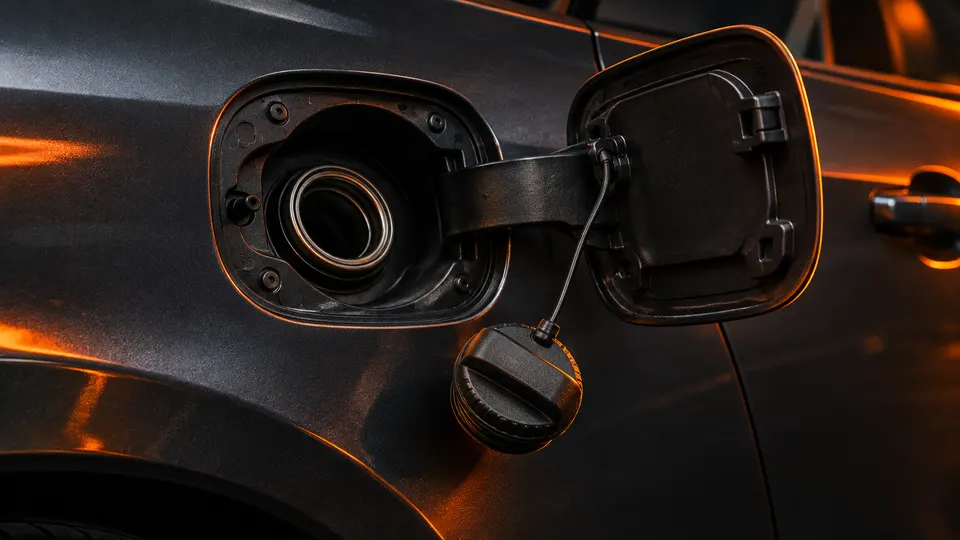
P0455 means your engine computer tried to seal the fuel vapor (EVAP) system for a leak test and found a large opening. The most common cause is a gas cap that is missing, loose, or damaged; a disconnected or split hose is next. The car usually drives normally, but fuel vapor is escaping, so check the cap today and get the leak fixed soon.
On this page
Key Takeaways
- P0455 is a "gross leak" code: the EVAP system could not hold vacuum or pressure at all, or close to it.
- Check the gas cap first. If it was left off or loose after a fill-up, that alone can set the code.
- Fix it soon. A strong fuel smell means more than a cap problem and should be checked before more driving.
- A missing or leaking cap can also fail a separate gas cap test in some inspection programs.
P0455 at a glance
- Meaning
- Evaporative Emission System Leak Detected (Gross Leak)
- System
- Emissions & Catalyst
- Severity
- Fix Soon The car usually drives normally, but fuel vapor is escaping and you may smell gas, so check the gas cap and get it repaired soon, sooner if there is a strong fuel smell.
- Common causes
- Missing, loose or damaged gas cap
- Disconnected or split EVAP hose
- Purge or vent valve stuck open
- Cracked charcoal canister
- Leaking fuel filler neck
- Applies to
- Generic OBD-II code: same meaning on all 1996 and newer cars and light trucks sold in the U.S.
What does P0455 mean?
P0455 stands for "Evaporative Emission System Leak Detected (Gross Leak)." Gasoline gives off vapor in the tank. The EVAP system stores that vapor in a charcoal canister and later feeds it to the engine to burn. It is a sealed system, so the engine computer can test it for leaks.
On many vehicles, the test works like this: the computer closes the vent valve, uses engine vacuum through the purge valve, then watches the tank pressure sensor. Some designs use a small pump instead, but the idea is the same. If it cannot pull or hold vacuum, the system is open somewhere. ALLDATA, a repair information company, puts it simply: the code means the EVAP system has detected a large leak somewhere in the system [1].
Detecting leaks is a federal requirement. The U.S. EPA lists the evaporative system among the systems OBD II must monitor, and notes that a missing fuel cap should be detected by the evaporative system check [2]. P0455 is the EVAP code for the biggest leaks, which is why a missing or loose cap is the first suspect.
Is it safe to drive with P0455?
You can usually drive the car, but treat P0455 as a "fix soon" code, not one to live with. Carista, a maker of diagnostic apps, lists the symptoms as the check engine light, a faint fuel smell near the rear of the vehicle, and usually no drivability problems [5].
Here is why we put it above the smaller EVAP leak codes:
- Fuel vapor is escaping. A large opening lets gasoline vapor out of the system every time the car sits, and that is the pollution the EVAP system exists to stop.
- A strong fuel smell changes the answer. If you smell strong raw fuel or see fuel dripping, do not keep driving: park away from heat and sparks and have it checked first. That points to a leak of liquid fuel, not just vapor.
- It can fail inspection twice. An active code keeps the light on, which fails the OBD check in states with emissions testing [3]. Some programs also test the cap itself. Washington, D.C. lists "gas cap leaks" and a missing or non-removable cap as typical reasons for failing its gas cap test [4].
- Your warning light is busy. While it is on for P0455, it cannot alert you to something new. If it ever starts flashing, read our guide to a flashing check engine light.
What causes P0455?
Causes are listed from most common and cheapest to least common. Every source we checked puts the gas cap first, but ALLDATA cautions that a loose or damaged cap is only one possible cause [1].
| Cause | Typical clue | Who can check it |
|---|---|---|
| Gas cap missing, loose, or wrong part | Code appeared right after a fill-up | You |
| Gas cap seal torn or hardened | Cap turns but the rubber is cracked or flat | You |
| EVAP hose disconnected or split | Hose hanging loose, cracked fitting | You for visible hoses; a shop for the rest |
| Purge valve stuck open | Sometimes rough running right after refueling | Shop or scanner with active tests |
| Vent valve stuck open | No outside sign | Shop or scanner with active tests |
| Cracked charcoal canister | Damage near the tank, often after road debris | Shop |
| Leaking filler neck | Rust or damage near the fuel door | Shop |
Carista lists the same core group: a loose, damaged, or missing cap, a cracked or disconnected EVAP hose, a failed purge or vent valve, and a cracked canister [5]. Identifix, a repair information provider, describes P0455 as the gross leak code, compared with about 0.040 inch for P0442 and about 0.020 inch for P0456 [6].
How do you diagnose P0455?
Start with free checks, and use a scanner before you spend money. Because a large leak is often something simple, most P0455 searches end at the gas cap or a hose you can see. If not, a smoke test finds the rest.
1. Scan first. Write down every stored and pending code and save the freeze frame. Other EVAP codes alongside P0455, such as a purge or vent circuit code, point the search toward that valve. If you have not used a scanner before, see our guide on how to use an OBD2 scanner.
2. Check the cap. Is it there? Did it click? Is the rubber seal whole? ALLDATA's first step is to make sure the cap is tightened properly and the seal is not cracked or damaged [1]. Replace a damaged cap with one made for your vehicle.
3. Look at the hoses you can reach. With the engine off and cool, trace the EVAP lines in the engine bay toward the purge valve. A hose that popped off is a common large leak. Do not work under a car that is supported only by a jack.
4. Drive and wait. The EVAP leak test is a periodic monitor. EPA guidance says these monitors run only after certain conditions are met, such as temperature and driving conditions [3]. Under OBD II the light goes off on its own after three consecutive trips without the fault [2].
5. Smoke test and valve tests. If the code comes back, a shop can fill the system with smoke to show the leak. Carista notes that the system is sealed at very low pressure, so a visual check alone often misses cracks [5]. A technician can also command the purge and vent valves with a scan tool to confirm they close.
How do you fix P0455, and what does it cost?
The repair matches the cause: a new gas cap, reconnecting or replacing a hose, a new purge or vent valve, or a canister or filler neck. We do not quote prices because we could not find a reliable, current U.S. source that covers these repairs. These factors set the bill:
- The part. A cap or a reconnected hose is a small job. A canister or vent valve mounted near the tank takes longer.
- Access. Parts under the car may need shields removed and the car raised on a lift.
- Diagnosis time. If the cap and visible hoses check out, expect to pay for a smoke test.
- Your inspection date. If you have a test coming up, fix the leak early so the monitors have time to run.
After the repair, the code can be cleared with a scanner. Clearing a code never repairs the leak; if the system is still open, P0455 returns after the next EVAP test. Clearing also resets the readiness monitors, and EPA guidance lists code clearing or a battery disconnection as reasons a car arrives at an inspection "not ready" [3]. Drive normally until the monitors complete.
How is P0455 different from P0442 and P0456?
All three come from the same EVAP leak test. P0455 means a large leak, P0442 a small one of about 0.040 inch, and P0456 a very small one of about 0.020 inch [6]. Large leaks are usually easier to find because the opening is bigger. If you are not sure what a second code on your scanner means, try our code lookup tool or browse the full trouble code list.
Frequently Asked Questions
Can I get P0455 from leaving my gas cap off?
Yes. A missing or loose cap is the classic cause, and the EPA notes that a missing fuel cap should be caught by the evaporative system check [2]. Put the cap back on until it clicks and drive normally for several days.
Why is P0455 still on after I tightened the gas cap?
The light does not go off right away. The EVAP test has to run and pass, and the light turns off after three consecutive trips without the fault. If the code returns after the test runs, the leak is somewhere else, such as a hose or valve.
Does P0455 cause a fuel smell?
It can. Carista lists a faint fuel smell near the rear of the vehicle as a symptom [5]. A strong smell or visible fuel is a different problem and should be checked before you keep driving.
Will a new gas cap pass my emissions test?
If the cap was the cause, a new cap fixes the leak, but you still need the code gone and the monitors ready. Washington, D.C. notes that in most cases replacing an old or missing cap lets a car pass its gas cap test [4]. Rules differ by state.
Our Take
We see P0455 as the EVAP code most likely to have a simple answer, and the sources back that up: every one we checked lists the gas cap first. So we would check the cap before anything else, then look for a hose that came loose. We still rank it as "fix soon" rather than "safe to ignore," because a large opening lets fuel vapor out all the time, and a cap problem can fail some inspections on its own. If a new cap does not clear it after several days of driving, we would pay for a smoke test before buying valves. And if there is a strong fuel smell, we would not keep driving until someone has looked.
Sources
- What Common OBD-II Codes Really Mean. ALLDATA DIY, 2026.
- On-Board Diagnostic (OBD) Regulations and Requirements: Questions and Answers. U.S. Environmental Protection Agency, 2003.
- Performing Onboard Diagnostic System Checks as Part of a Vehicle Inspection and Maintenance Program. U.S. Environmental Protection Agency, 2001.
- Common Causes of Inspection Failure, Personal Vehicles. DC DMV.
- P0455: Evaporative Emission Control System Gross Leak Detected. Carista, 2026.
- P0442 Code: Causes, Diagnosis, and Quick Solutions. Identifix, 2025.
This is general information to help you understand your vehicle, not a substitute for a hands-on diagnosis. If a warning light is flashing or the car runs badly, stop driving and have it checked by a qualified technician. Spotted an error? Tell us.
Keep Reading
P0420 on Nissan: Campaigns, Sensor Names and What to Check
P0420 on a Nissan: the Sentra SULEV emission campaign, how Nissan names its A/F and rear O2 sensors, what to check first, and when a dealer visit is free.
P0430 Code: Catalyst Efficiency Below Threshold (Bank 2)
P0430 means the Bank 2 catalytic converter on a V6 or V8 tests below its limit. See if it is safe to drive, what causes it, how to check it and what fixes cost.
P0430 on Ford: Recall 24E04, Bulletins and What to Check
P0430 on a Ford truck may be a software calibration issue. See Emission Recall 24E04 for F-150 hybrids, the 7.3L bulletins, safety and what to check first.
P0442 Code: Small EVAP Leak Detected
P0442 means your EVAP system found a small fuel vapor leak, about 0.040 inch. Learn if it is safe to drive, the common causes, and the checks to do first.
P0456 Code: Very Small EVAP Leak
P0456 means your EVAP system found a very small vapor leak. Learn what it means, if it is safe to drive, the usual causes, and the cheap checks to do first.
P0700 Code: Transmission Control System Malfunction
P0700 means the transmission computer found a fault and asked for the check engine light. Learn what causes it, if it is safe to drive, and how to diagnose it.