P0442 Code: Small EVAP Leak Detected
Quick Answer
P0442 means the engine computer ran its fuel vapor (EVAP) leak test and found a small leak, roughly 0.040 inch across. It does not change how the car drives, so it is generally safe to keep driving while you find it. Start with the gas cap and its seal, then the hoses you can see. If the code comes back, a smoke test is the reliable way to find the leak.
On this page
Key Takeaways
- P0442 is a test result, not a part name: the EVAP system leaked a little during its self-test.
- The car drives normally, but the code keeps the check engine light on and can fail an emissions test.
- The cheapest checks come first: gas cap, filler neck seal, visible hoses.
- After a fix, the light needs several days of normal driving to go off, and clearing the code only hides the problem until the next test.
P0442 at a glance
- Meaning
- Evaporative Emission System Leak Detected (Small Leak)
- System
- Emissions & Catalyst
- Severity
- Safe to Drive It does not affect how the car drives, but it lets fuel vapor escape and will fail an emissions inspection, so still get it checked soon and watch for a flashing light.
- Common causes
- Loose or worn gas cap
- Small crack in an EVAP hose
- Leaking purge valve or vent solenoid
- Worn O-ring or seal at the filler neck
- Leaking charcoal canister
- Applies to
- Generic OBD-II code: same meaning on all 1996 and newer cars and light trucks sold in the U.S.
What does P0442 mean?
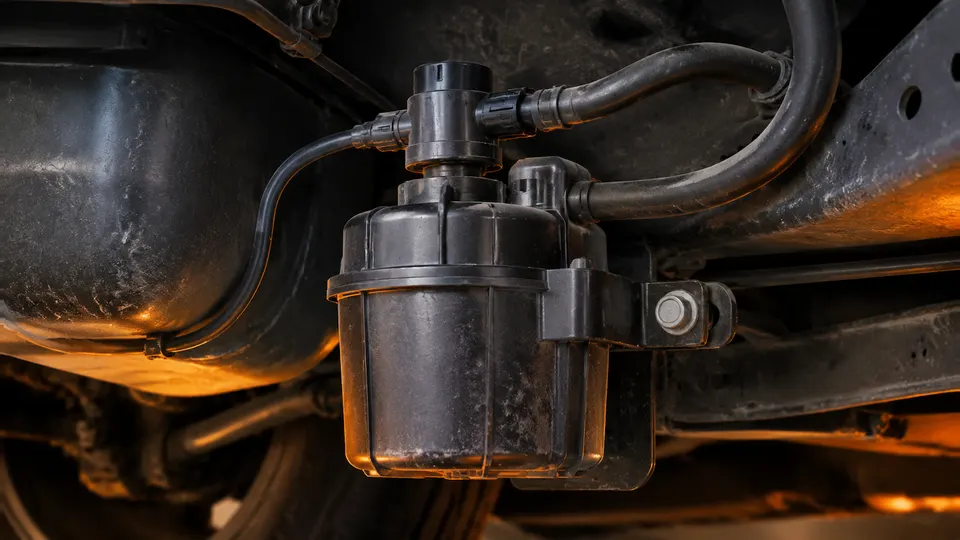
P0442 stands for "Evaporative Emission System Leak Detected (Small Leak)." Your fuel tank constantly gives off gasoline vapor. The EVAP system catches that vapor in a charcoal canister and later lets the engine burn it. To make sure the system is sealed, the engine computer closes it off and checks whether it holds pressure or vacuum.
Identifix, a repair information provider, explains that P0442 means the computer found a leak bigger than its threshold but too small to count as a gross leak, about 0.040 inch in diameter. A leak anywhere from the fuel cap to the purge valve can set it [1].
That 0.040 inch size is not random. The U.S. EPA says federal OBD rules require cars to detect a leak of 0.040 inch or larger, while California's rules go down to 0.020 inch [2]. A P0442 leak is small, but it is exactly the size the federal rules were written to catch.
Is it safe to drive with P0442?
Yes, in most cases. Carista, a maker of diagnostic apps, rates P0442 as low severity: the check engine light comes on, you may notice a faint fuel smell now and then, and driving is unaffected [3].
Still, plan to fix it rather than live with it:
- Emissions inspection. EPA guidance says a car passes the OBD check only when no trouble code is commanding the light on and the required readiness monitors are set [4]. An active P0442 can fail you.
- A blind spot. With the light already on, a new fault will not get your attention the same way. If the light ever starts flashing, that is urgent; see our guide to a flashing check engine light.
- Strong fuel smell. A small vapor leak should not make the car reek of gasoline. If it does, or you see fuel on the ground, park it away from heat and have it inspected before driving more.
What causes P0442?
Here are the usual causes, cheapest and most common first. Haynes notes that while a loose fuel cap may trigger P0442, deeper inspection may reveal hose or seal problems [5].
| Cause | What to look for | Who can check it |
|---|---|---|
| Loose or worn gas cap | Cap not clicked; seal cracked, flat, or hard | You |
| Filler neck seal or lip | Rust or nicks where the cap seals | You |
| Small split in an EVAP hose | Cracked rubber, loose clamp, unlatched connector | You for visible hoses; a shop for others |
| Purge valve leaking | Often paired with a purge code | Shop, or a scanner with active tests |
| Vent valve or solenoid leaking | Often paired with a vent code | Shop, or a scanner with active tests |
| Leaking charcoal canister | Usually no visible sign | Shop, with a smoke test |
| Tank pressure sensor, sending unit gasket, or tank | Found during a smoke test | Shop |
Identifix lists the same group: loose cap, damaged hoses or fittings, purge or vent valves, the charcoal canister, a cracked or corroded filler neck, the tank pressure sensor, and a leaking tank or sending unit gasket [1]. Carista adds a worn O-ring on the fuel filler neck [3].
Some automakers have bulletins for EVAP leak codes. Identifix points to a Nissan bulletin, NTB13-097, covering P0442, P0455, and P0456 on many 2012 and newer models [1]. Ask a dealer or shop to check bulletins for your exact vehicle; our VIN decoder shows the model details you will need.
How do you diagnose P0442?
Go in order, from free to paid. Do not buy a purge valve, vent valve, or canister until a test shows the leak is there.
- Scan for everything. Record all stored and pending codes and the freeze frame data. Identifix recommends reviewing all codes before deciding on a repair [1]. A purge or vent valve code next to P0442 narrows the search. New to scanners? Read how to use an OBD2 scanner.
- Inspect the gas cap. Check that the seal is whole and soft and that the filler pipe lip is clean and smooth. Tighten it until it clicks. Carista says tightening or replacing the cap clears the code on a surprising number of vehicles [3].
- Look at the hoses. With the engine off and cool, follow the EVAP lines you can see from the purge valve back toward the canister. Never crawl under a car held up only by a jack.
- Drive normally and wait. Give the EVAP test time to run, as shown in the timeline below.
- Smoke test. If the code returns, a shop fills the system with smoke to find the leak. Identifix warns that a clean smoke test does not always mean the system is sealed, since a leak can close under low pressure and open under vacuum [1].
- Valve tests. A technician can command the purge and vent valves with a scan tool to check that each one seals.
How long until the light goes off after a fix?
Longer than most people expect. The EVAP leak test is not continuous. EPA guidance explains that the evaporative system monitor is one of the periodic monitors, which run only after a set of conditions are met, such as ambient temperature and driving conditions [4]. Under OBD II, the light goes off after three consecutive trips in which the problem does not come back [2].
You can clear the code with a scanner after a repair. Clearing P0442 does not fix the leak; if it is still there, the code comes back the next time the test runs. Clearing also resets readiness monitors, and EPA guidance names code clearing and battery disconnection as reasons a car shows up "not ready" for inspection [4].
How do you fix P0442, and what does it cost?
The fix follows the diagnosis: a gas cap, a hose or connector, a purge or vent valve, a canister, or a seal at the tank. We do not give dollar amounts because we could not find a reliable, current U.S. price source covering these repairs. The cost depends on:
- Which part leaks. A cap is a quick fix. Parts mounted near the tank take more labor.
- How long the search takes. Shops charge diagnostic time, and small leaks can be slow to pin down.
- Bulletins. A known fix for your model can shorten the search.
- Part fit. EVAP parts must seal exactly; a poor fit can bring the code back.
If you take the car to a shop, bring what you already know. It saves diagnostic time and keeps the shop from repeating checks you have done:
- The full list of codes, including pending ones, and the freeze frame data you saved.
- What you already tried, such as a new cap, and how many days you drove afterward.
- When the light came on. Right after a fill-up points toward the cap or filler neck.
- Any other signs, such as a fuel smell, trouble filling the tank, or rough running after refueling.
- Any other EVAP codes from the past, since a leak that keeps returning can be a different part each time.
Ask whether the shop will smoke test the system before replacing parts, and whether they checked for service bulletins on your model.
How is P0442 different from P0455 and P0456?
They come from the same test and differ only in leak size. P0456 is the smallest, about 0.020 inch, and P0455 is a large or gross leak [1]. If your scanner shows other codes too, look them up with our code lookup tool or the trouble code index.
Frequently Asked Questions
Can a gas cap cause P0442?
Yes. A loose or worn cap is the first cause every source lists. Carista says tightening or replacing it clears the code on a surprising number of vehicles [3]. Give it several days of normal driving before deciding it did not work.
Is P0442 serious?
Not for the engine. It does not affect how the car drives. It matters for emissions, for passing inspection, and for keeping your warning light free to report new problems.
Will P0442 go away by itself?
Only if the leak goes away, for example after you tighten a loose cap. The light then turns off after three consecutive trips without the fault [2]. A cracked hose or worn seal will not heal, so the code will keep returning.
Our Take
We think P0442 rewards patience and order. The sources line up on the gas cap and filler neck seal as the first stop, and those checks cost little. We would tighten or replace the cap, look over the visible hoses, and then actually wait: the EVAP test only runs under certain conditions, so judging a fix after one drive is too early. If the code returns, we would pay for a smoke test before buying any valve, because guessing on EVAP parts adds up. And we would never clear the code before an inspection hoping it stays away; it will not, and the monitors will show it.
Sources
- P0442 Code: Causes, Diagnosis, and Quick Solutions. Identifix, 2025.
- On-Board Diagnostic (OBD) Regulations and Requirements: Questions and Answers. U.S. Environmental Protection Agency, 2003.
- P0442 Code: Evaporative Emission Control System Small Leak Detected. Carista, 2026.
- Performing Onboard Diagnostic System Checks as Part of a Vehicle Inspection and Maintenance Program. U.S. Environmental Protection Agency, 2001.
- OBD2 Codes List: Your Go-To Reference. Haynes, 2026.
This is general information to help you understand your vehicle, not a substitute for a hands-on diagnosis. If a warning light is flashing or the car runs badly, stop driving and have it checked by a qualified technician. Spotted an error? Tell us.
Keep Reading
P0420 on Nissan: Campaigns, Sensor Names and What to Check
P0420 on a Nissan: the Sentra SULEV emission campaign, how Nissan names its A/F and rear O2 sensors, what to check first, and when a dealer visit is free.
P0430 Code: Catalyst Efficiency Below Threshold (Bank 2)
P0430 means the Bank 2 catalytic converter on a V6 or V8 tests below its limit. See if it is safe to drive, what causes it, how to check it and what fixes cost.
P0430 on Ford: Recall 24E04, Bulletins and What to Check
P0430 on a Ford truck may be a software calibration issue. See Emission Recall 24E04 for F-150 hybrids, the 7.3L bulletins, safety and what to check first.
P0455 Code: Large EVAP Leak Detected
P0455 means a large leak in the fuel vapor (EVAP) system, often a missing or loose gas cap. See what it means, how soon to fix it, causes, and first checks.
P0456 Code: Very Small EVAP Leak
P0456 means your EVAP system found a very small vapor leak. Learn what it means, if it is safe to drive, the usual causes, and the cheap checks to do first.
P0700 Code: Transmission Control System Malfunction
P0700 means the transmission computer found a fault and asked for the check engine light. Learn what causes it, if it is safe to drive, and how to diagnose it.