P0430 Code: Catalyst Efficiency Below Threshold (Bank 2)
Quick Answer
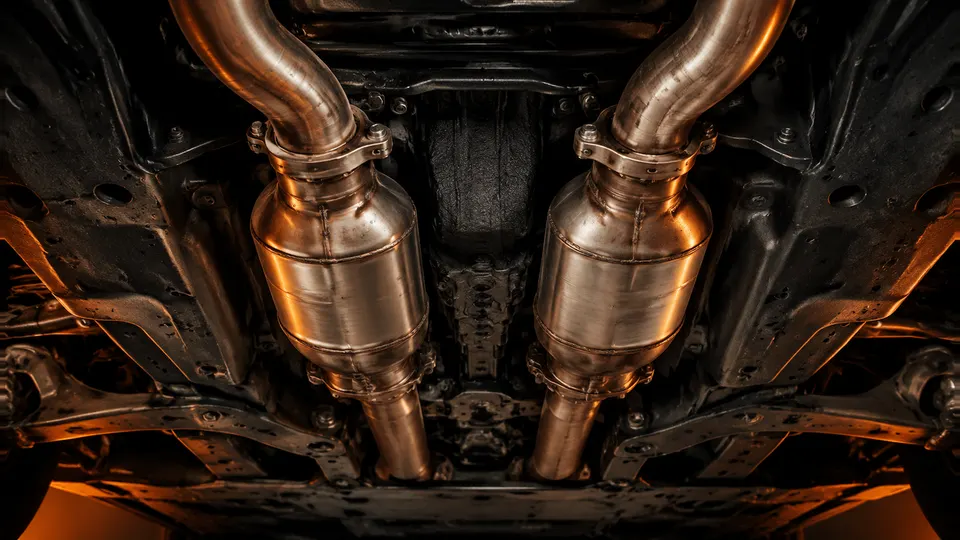
P0430 means your engine computer thinks the catalytic converter on Bank 2, the side of a V6 or V8 engine without cylinder 1, is not cleaning the exhaust well enough. It is usually safe to drive in the short term, but get it checked soon. A worn converter is common, yet a bad rear oxygen sensor or an exhaust leak on that side can set the same code.
On this page
Key Takeaways
- P0430 is the Bank 2 version of P0420. It only appears on engines with two cylinder banks, such as a V6 or V8.
- It is usually safe to drive for now. If the check engine light flashes or the engine shakes, pull over and stop driving.
- P0430 alone points to something on the Bank 2 side. P0420 and P0430 together point to something both sides share.
- Fix misfires, fuel mixture problems, leaks and sensors before replacing a converter, and check your 8-year or 80,000-mile emissions warranty.
P0430 at a glance
- Meaning
- Catalyst System Efficiency Below Threshold (Bank 2)
- System
- Emissions & Catalyst
- Severity
- Safe to Drive Usually safe to drive in the short term because it rarely affects how the car runs, but still get it checked soon and watch for a flashing light.
- Common causes
- Worn-out or damaged bank 2 catalytic converter
- Faulty bank 2 downstream oxygen sensor
- Exhaust leak ahead of or between the sensors
- Misfire or long-term rich/lean running
- Engine burning oil or coolant
- Applies to
- Generic OBD-II code: same meaning on all 1996 and newer cars and light trucks sold in the U.S.
What does P0430 mean?
P0430 stands for "Catalyst System Efficiency Below Threshold (Bank 2)" [1]. It is the same test as P0420, run on the other side of the engine. Your powertrain control module (PCM) compares the oxygen sensor in front of the converter with the sensor behind it. When the rear signal starts to look too much like the front one, the PCM decides the converter has lost efficiency and turns on the check engine light [2].
A V6 or V8 has two rows of cylinders. Bank 1 is the side with cylinder 1. Bank 2 is the other side. Each bank usually has its own converter and its own pair of oxygen sensors, which is why a V engine can set one code without the other.
Which side is Bank 2 depends on the engine, so never assume. Honda, for example, labels P0430 as the "front bank" on some V6 models in a 2021 warranty notice [3]. Check the service information for your engine before you buy a sensor or a converter.
Is it safe to drive with P0430?
Yes, P0430 is usually safe to drive in the short term. Most drivers notice nothing but the light, because the converter test does not change how the engine runs. Some code libraries list a slight loss of power, a sulfur smell or lower fuel economy as possible signs [1]. Those point to a converter that is further gone, so do not put the visit off.
The exception is a misfire. If the check engine light starts flashing, or the engine shakes badly, pull over and stop driving. A flashing light means unburned fuel is reaching the converter, where it can overheat and destroy it. Our guide to a flashing check engine light explains what to do next, and P0300 covers misfire codes.
The light also matters for registration. California's Bureau of Automotive Repair says a vehicle will not pass a Smog Check with the check engine light on [4].
What causes P0430?
The usual causes, most common first:
- Worn or damaged Bank 2 catalytic converter.
- Faulty Bank 2 downstream oxygen sensor. A slow rear sensor can make a good converter fail the test.
- Exhaust leak before or between the Bank 2 sensors. A cracked manifold or a leaking gasket lets air in and confuses the readings.
- Long-term rich or lean running, or misfires, which overheat or coat the converter.
- An engine burning oil or coolant.
Carista lists the same group of causes for P0430 [1]. Identifix adds leaking injectors, high fuel pressure, wrong fuel, a bad coolant temperature sensor or thermostat, and outdated PCM software to the list for catalyst efficiency codes [2]. A lean code on the same side, P0174, is a strong hint that a vacuum or fuel problem is involved.
What does it mean when P0420 and P0430 appear together?
This is the most useful clue a V engine gives you. When both banks fail the converter test at once, look for a cause the two sides share before blaming two converters. Something that affects only one side, like a leaking gasket or a bad sensor, rarely sets both codes.
Software is a real possibility. Ford has issued bulletins for P0420 and P0430 set by PCM calibration on certain trucks, including 2022 to 2023 F-150 trucks with the 3.5L PowerBoost hybrid engine [5]. Honda extended warranty coverage on some 2016 to 2018 V6 models for the same pair of codes [3]. See P0430 on Ford and P0420 on Honda.
How do you diagnose P0430?
Work from the cheapest checks up. A scanner that shows live data and freeze frame is enough for the first steps; see how to use an OBD2 scanner, and use our code lookup for any other codes.
- Read every code and save the freeze frame. Misfire and fuel trim codes come first.
- Compare the banks in live data. Look at short and long term fuel trims for each bank, and watch both rear oxygen sensors on a warm engine. A Bank 2 rear sensor that switches like its front sensor, while Bank 1 stays steady, points to the Bank 2 converter [2].
- Inspect the Bank 2 exhaust for leaks with the engine cold: soot marks, broken studs and ticking at startup.
- Have the rear sensor tested. A technician confirms it responds to forced rich and lean conditions.
- Ask a dealer to check your VIN for software updates, bulletins and open recalls.
- Confirm the converter with temperature and back pressure checks before replacing it.
The big advantage of a V engine is that you have a built-in comparison. Bank 1 and Bank 2 see the same fuel, the same driving and the same software. If Bank 1's rear sensor stays calm and Bank 2's rear sensor busily switches, the difference is on the Bank 2 side. If both rear sensors look busy, the cause is more likely something the whole engine shares. Write down the freeze frame values before anyone clears the code, because they show the engine speed, load, temperature and fuel trims at the moment P0430 set.
Steps 1 to 3 are fair driveway checks with a basic scanner and a flashlight. Leave work under a hot or running vehicle, and anything on a lift, to a qualified technician. Exhaust parts stay hot long after the engine is shut off.
How do you fix P0430, and what does it cost?
The repair matches the finding: a gasket, a sensor, a misfire fix, a software update or a converter. Replacing the Bank 2 converter without fixing what damaged it often brings P0430 back. If a misfire or an oil burning problem ruined the old converter, the new one faces the same conditions. As of November 2026, Identifix cites RepairPal averages of $454 to $550 for an oxygen sensor replacement and $2,301 to $2,473 for a catalytic converter replacement [2]. What moves your bill: whether the converter is a separate pipe section or built into the exhaust manifold, how much has to come apart to reach the Bank 2 side, labor rates in your area, and whether your state requires a specific type of replacement converter. Ask the shop to show you the test results that justify a converter before you approve one.
Before paying, check coverage. Federal rules set an 8-year or 80,000-mile warranty period for catalytic converters on light-duty vehicles and trucks [6].
After the repair, clearing the code only turns the light off. It does not fix anything, and inspection stations check that the readiness monitors have finished their self tests. California's BAR suggests driving a week or two after repairs so the monitors can reset [4]. Removing or disabling emissions equipment is never an option: tampering with a vehicle's emissions controls is illegal under the Clean Air Act [7].
Frequently Asked Questions
Can I just replace the Bank 2 oxygen sensor?
Only if testing shows the sensor is bad. A rear sensor that copies the front sensor is often reporting a weak converter correctly, so a new sensor would not fix the code.
Why do I have P0430 but not P0420?
Because each bank has its own converter and sensors. A problem on one side, such as a leak, a slow sensor or a misfire in one bank, only affects that bank's test.
Is a four-cylinder car able to set P0430?
Normally no. Inline engines have a single bank, so they use P0420. P0430 needs a second bank, as on a V6 or V8.
Can P0430 damage my engine?
The code itself does not damage anything. It is a report that one converter tested weak. The risk comes from what may have caused it: an ongoing misfire, a rich mixture or burning oil can keep hurting the converter and, in the case of oil or coolant loss, the engine. A badly clogged converter can also restrict the exhaust and cost power. That is why the cause deserves a diagnosis even when the car feels normal.
Will P0430 make my car fail inspection?
In most OBD-based programs, yes, because the check engine light is on. California's Smog Check fails a vehicle with the light on [4].
Our Take
We read P0430 as a question about one side of the engine. If it shows up alone, we would focus on the Bank 2 exhaust: leaks, the rear sensor and the converter itself, in that order. If P0420 shows up with it, we would stop looking at parts and start looking at causes both banks share, such as fuel mixture, misfires, oil burning or software. The Ford and Honda documents show that software really does set these codes on some vehicles, so a VIN check at a dealer is cheap insurance. Drive gently in the meantime, and stop if the light flashes.
Sources
- P0430 Code: Catalyst System Efficiency Below Threshold (Bank 2). Carista, 2026.
- P0420 Code: The Guide to Diagnosis and Fast Fixes. Identifix, 2025.
- Warranty Extension: MIL Comes On with DTC P0420/P0430, P030x, and/or P219A/B. American Honda Motor Co., Inc. (via NHTSA), 2021.
- Smog Check. California Bureau of Automotive Repair, 2026.
- Technical Service Bulletin 25-2233: Illuminated MIL With DTC P0420 And/Or P0430. Ford Motor Company (via NHTSA), 2025.
- 40 CFR 85.2103, Emission performance warranty. Cornell Law School Legal Information Institute, 2026.
- Tampering and Aftermarket Defeat Devices. U.S. Environmental Protection Agency (Clean Air Northeast), 2026.
This is general information to help you understand your vehicle, not a substitute for a hands-on diagnosis. If a warning light is flashing or the car runs badly, stop driving and have it checked by a qualified technician. Spotted an error? Tell us.
Keep Reading
P0420 on Nissan: Campaigns, Sensor Names and What to Check
P0420 on a Nissan: the Sentra SULEV emission campaign, how Nissan names its A/F and rear O2 sensors, what to check first, and when a dealer visit is free.
P0430 on Ford: Recall 24E04, Bulletins and What to Check
P0430 on a Ford truck may be a software calibration issue. See Emission Recall 24E04 for F-150 hybrids, the 7.3L bulletins, safety and what to check first.
P0442 Code: Small EVAP Leak Detected
P0442 means your EVAP system found a small fuel vapor leak, about 0.040 inch. Learn if it is safe to drive, the common causes, and the checks to do first.
P0455 Code: Large EVAP Leak Detected
P0455 means a large leak in the fuel vapor (EVAP) system, often a missing or loose gas cap. See what it means, how soon to fix it, causes, and first checks.
P0456 Code: Very Small EVAP Leak
P0456 means your EVAP system found a very small vapor leak. Learn what it means, if it is safe to drive, the usual causes, and the cheap checks to do first.
P0700 Code: Transmission Control System Malfunction
P0700 means the transmission computer found a fault and asked for the check engine light. Learn what causes it, if it is safe to drive, and how to diagnose it.