P0456 on Jeep and Dodge: Very Small EVAP Leak Causes
Quick Answer
On a Jeep or Dodge, P0456 means the evaporative (EVAP) system found a very small fuel vapor leak, the same meaning as on any car. The make-specific part is the dealer test: FCA bulletin 18-089-19 requires a scan-tool Small Leak Verification Test during diagnosis and again after repair. It is usually safe to drive. Check the gas cap first, then have the leak found with the right test.
On this page
- What does P0456 mean on a Jeep or Dodge?
- What makes P0456 different on Jeep and Dodge?
- Is it safe to drive a Jeep or Dodge with P0456?
- What causes P0456 on a Jeep or Dodge?
- How do you check P0456 on a Jeep or Dodge?
- What does a P0456 repair cost on a Jeep or Dodge?
- Frequently Asked Questions
- Our Take
- Sources
Key Takeaways
- P0456 is a very small EVAP leak, about 0.020 inch. The car usually drives normally.
- FCA US bulletin 18-089-19 makes the wiTECH Small Leak Verification Test (SLVT) part of P0456 diagnosis, and a required recheck after any repair.
- The bulletin says a road test cannot confirm the fix, because the code only sets under specific conditions.
- Start with the gas cap and filler neck, then visible hoses. Do not replace valves or the canister on a guess.
P0456 at a glance
- Meaning
- Evaporative Emission System Leak Detected (Very Small Leak)
- System
- Emissions & Catalyst
- Severity
- Safe to Drive It does not affect how the car drives and is often just the gas cap, but it will fail an emissions inspection, so still get it checked soon and watch for a flashing light.
- Common causes
- Loose, worn or wrong gas cap
- Leaking vent valve or its O-ring seal
- Slightly leaking purge valve
- Cracked EVAP hose or charcoal canister
- Worn seal at the fuel filler neck
- Applies to
- Generic OBD-II code: same meaning on all 1996 and newer cars and light trucks sold in the U.S.
What does P0456 mean on a Jeep or Dodge?
P0456 stands for "Evaporative Emission System Leak Detected (Very Small Leak)." The code means the same thing on a Grand Cherokee, a Wrangler, a Charger or a Ram pickup. Gasoline gives off vapor all the time. The EVAP system traps that vapor in a charcoal canister and later feeds it to the engine to burn. Our main P0456 guide explains the full system.
To prove the system is sealed, the engine computer closes the vent and purge valves and watches the pressure in the tank. If the pressure drifts too fast, something leaks. P0456 is the code for the smallest leak size the computer looks for, roughly 0.020 inch, so the cause is often a worn seal or a tiny crack you cannot see. The U.S. EPA explains that federal OBD rules require detection of a 0.040 inch leak, while California's OBD II rules go down to 0.020 inch, and many automakers build one system for all 50 states [7].
The Jeep and Dodge difference is not in what the code means. It is in how the maker tells its dealers to prove the leak. That is covered next.
What makes P0456 different on Jeep and Dodge?
FCA US, the company behind these brands in the bulletin years, issued a bulletin built around this one code. The NHTSA-hosted bulletin 18-089-19, dated November 1, 2019, is titled "wiTECH Small Leak Verification Test (SLVT) - P0456-EVAP SYSTEM SMALL LEAK." CarComplaints, which republishes NHTSA bulletin records, lists it against the 2018 Dodge Durango [4]. The NHTSA copy is at static.nhtsa.gov.
What the bulletin tells technicians, as we read it:
- The SLVT is a scan-tool routine run from FCA's wiTECH diagnostic software, and it is a required step when P0456 is being diagnosed.
- The test is run again after any repair or part replacement, including a software update.
- A road test does not prove the repair, because P0456 sets only after specific engine-off and drive conditions.
- Its scope is FCA US gasoline vehicles, model years 2015 to 2020, that carry the test [1].
The bulletin is written for the whole FCA lineup, not one model. That puts Jeep, Dodge and Ram vehicles of those years in scope, including Grand Cherokee, Wrangler, Durango, Charger and Ram 1500, though a dealer should confirm your exact vehicle by VIN. Our VIN decoder shows the basics.
Two more NHTSA-hosted FCA documents point the same way. Bulletin 18-093-19 (November 2019) tells technicians to use the SLVT to decide whether a P0456 leak exists [2]. Bulletin 18-031-20 (April 2020) repeats the SLVT step and adds reprogramming the PCM with the latest software [3].
Is it safe to drive a Jeep or Dodge with P0456?
Yes, in most cases. A very small EVAP leak does not change how the engine runs. Carista, a maker of diagnostic apps, lists no drivability symptoms for P0456 beyond the warning light and an occasional faint fuel smell [5].
Three cautions still apply:
- A strong fuel smell is different. If you smell raw gasoline or see a drip, park away from heat and have the vehicle checked before driving it again.
- A flashing light is a different problem. If the check engine light flashes or the engine shakes, pull over and stop driving. Our guide to a flashing check engine light explains why.
- Inspection. The EPA says a vehicle passes the OBD check only when no code commands the light on and the required readiness monitors are set [8]. In a state with emissions testing, an active P0456 can fail.
What causes P0456 on a Jeep or Dodge?
We found no official Jeep or Dodge document that names a failing part for P0456. The FCA bulletins describe a test procedure, not a known bad component. So the cause list is the standard one, ordered from cheapest to costliest. Carista and Identifix both put the fuel cap first, and Carista also names a worn O-ring at the fuel filler neck [5] [6].
| Cause | What you might notice | Who can check it |
|---|---|---|
| Gas cap loose, worn or wrong part | Light after a fill-up; cracked or flat seal | You |
| Filler neck seal or rust at the cap opening | Rough or corroded sealing lip | You, by looking |
| Cracked EVAP hose or loose connector | Brittle hose, fitting that wiggles | You for visible hoses; a shop for the rest |
| Purge valve leaking slightly | Sometimes rough idle after refueling | Shop or scan tool with active tests |
| Vent valve or its seal | Sometimes trouble filling the tank | Shop or scan tool with active tests |
| Cracked charcoal canister | Often no sign at all | Shop, with a leak test |
The valve and canister rows come from the data we use for this code: a leaking vent valve or its O-ring, a slightly leaking purge valve, and a cracked hose or canister. Because the leak is tiny, a cap that looks fine can still be at fault if its seal has hardened with age.
Software is the other thing to keep in mind. Bulletin 18-031-20 includes reprogramming the PCM, so ask a dealer whether an update is available for your VIN before paying for parts.
How do you check P0456 on a Jeep or Dodge?
Work from free checks to paid tests. Do not replace the purge valve, vent valve or canister until a test shows where the leak is.
- Read everything the scanner shows. Note every stored and pending code and save the freeze frame. Identifix advises reviewing all codes before settling on a repair [6]. See how to use an OBD2 scanner.
- Check the gas cap. Remove it, look at the rubber seal, wipe the lip of the filler neck and reinstall it until it clicks. If the seal is cracked or hard, replace the cap with one made for your vehicle.
- Look at what you can see. With the engine off and cool, follow the visible EVAP hoses and look for cracks or connectors that are not fully latched. Do not crawl under a vehicle that is only on a jack.
- If the code returns, ask for a leak test that fits the bulletin. Carista says a smoke test is essentially required for a leak this small, and Identifix warns a clean smoke test does not always clear the system [5]. At an FCA dealer, the SLVT is the step the bulletin names.
- Retest after any repair. FCA's bulletin says a road test does not confirm the fix [1].
The EVAP monitor also does not run on every trip. The EPA lists it among the periodic monitors that need specific conditions, and says the light goes out after three consecutive trips without the fault [8]. After a cap fix, expect a few days of normal driving before the light clears.
What does a P0456 repair cost on a Jeep or Dodge?
We found no reliable, current U.S. price source for Jeep or Dodge EVAP repairs, so we do not list dollar figures. What drives the cost is clearer:
- Where the leak is. A cap or an engine bay hose is quick. A valve or canister near the tank can mean lifting the vehicle and removing shields.
- How long the search takes. Shops charge for diagnostic time, and a very small leak can take longer to find than a large one.
- Software. If a PCM update applies, as in bulletin 18-031-20, the labor is different from a parts repair.
- Parts fit. EVAP parts must seal well. A poor-fitting cap can bring the light right back.
Get a written estimate that names the failed part and the test that found it. Clearing the code does not fix anything, and inspection stations check readiness monitors, so never clear a code to get through a test. Never consider removing or disabling emissions equipment; tampering is illegal under the Clean Air Act [9]. Related leak codes are P0442, a small leak, and P0455, a large one. Other codes? Try our code lookup.
Frequently Asked Questions
Is there a Jeep or Dodge recall for P0456?
We found no recall or warranty extension for P0456 in the NHTSA documents we reviewed. What we found are service bulletins about the test procedure. A dealer can check your VIN for open recalls and campaigns.
Why does a Jeep Grand Cherokee or Ram keep setting P0456 after a new gas cap?
A new cap only helps if the cap was the leak. The FCA bulletin says to prove the leak with the SLVT and to retest after repair, because a road test cannot confirm the fix [1]. If the code returns, the leak is elsewhere: a hose, valve, seal or canister.
Does P0456 mean my fuel tank is leaking?
Not necessarily. The code covers any very small leak between the gas cap and the purge valve. Fuel dripping under the vehicle or a strong gas smell is a separate and more urgent issue, so have it checked right away.
Can I pass an emissions test with P0456?
Usually not while the light is on. EPA guidance says the vehicle passes the OBD check when no code commands the light on and the readiness monitors are set [8]. Fix the leak, then drive until the monitors are ready.
Our Take
We think Jeep and Dodge owners should treat P0456 as a cheap-first, test-before-parts code. The official FCA documents we found do not blame a single part. They say the leak must be proven with the SLVT and rechecked after repair, and that a road test is not proof. So we would start with the gas cap and filler neck, look over the visible hoses, and then ask a dealer or shop for a real leak test rather than buy valves on a guess. We would also ask whether software applies to the VIN. And we would not clear the code and hope.
Sources
- wiTECH Small Leak Verification Test (SLVT) - P0456 EVAP System Small Leak (bulletin 18-089-19). FCA US (via NHTSA), 2019.
- Bulletin 18-093-19, P0456 EVAP leak diagnosis with the SLVT. FCA US, 2019.
- Bulletin 18-031-20, P0456 SLVT and PCM software. FCA US, 2020.
- 2018 Dodge Durango TSB 18-089-19. CarComplaints, 2018.
- P0456: Evaporative Emission System Very Small Leak Detected. Carista, 2026.
- P0442 Code: Causes, Diagnosis, and Quick Solutions. Identifix, 2025.
- On-Board Diagnostic (OBD) Regulations and Requirements: Questions and Answers. U.S. Environmental Protection Agency, 2003.
- Performing Onboard Diagnostic System Checks as Part of a Vehicle Inspection and Maintenance Program. U.S. Environmental Protection Agency, 2001.
- Tampering and Aftermarket Defeat Devices. U.S. EPA, 2026.
This is general information to help you understand your vehicle, not a substitute for a hands-on diagnosis. If a warning light is flashing or the car runs badly, stop driving and have it checked by a qualified technician. Spotted an error? Tell us.
Keep Reading
P0420 on Nissan: Campaigns, Sensor Names and What to Check
P0420 on a Nissan: the Sentra SULEV emission campaign, how Nissan names its A/F and rear O2 sensors, what to check first, and when a dealer visit is free.
P0430 Code: Catalyst Efficiency Below Threshold (Bank 2)
P0430 means the Bank 2 catalytic converter on a V6 or V8 tests below its limit. See if it is safe to drive, what causes it, how to check it and what fixes cost.
P0430 on Ford: Recall 24E04, Bulletins and What to Check
P0430 on a Ford truck may be a software calibration issue. See Emission Recall 24E04 for F-150 hybrids, the 7.3L bulletins, safety and what to check first.
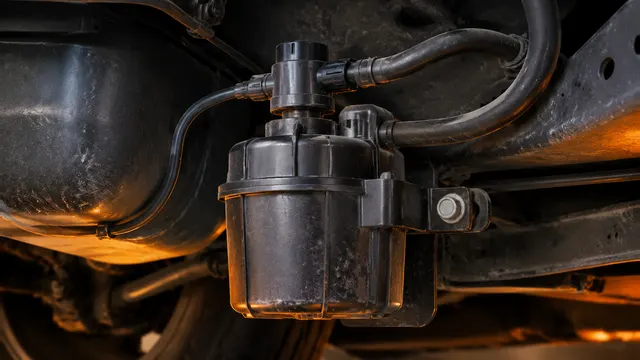
P0442 Code: Small EVAP Leak Detected
P0442 means your EVAP system found a small fuel vapor leak, about 0.040 inch. Learn if it is safe to drive, the common causes, and the checks to do first.
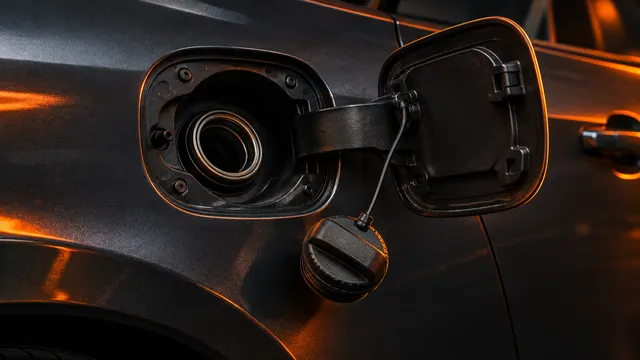
P0455 Code: Large EVAP Leak Detected
P0455 means a large leak in the fuel vapor (EVAP) system, often a missing or loose gas cap. See what it means, how soon to fix it, causes, and first checks.
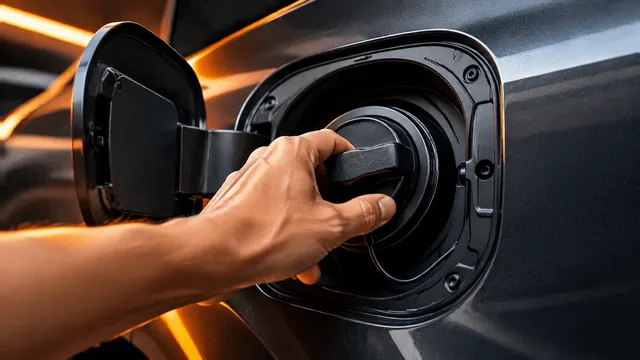
P0456 Code: Very Small EVAP Leak
P0456 means your EVAP system found a very small vapor leak. Learn what it means, if it is safe to drive, the usual causes, and the cheap checks to do first.