P0128 Code: Coolant Thermostat Below Regulating Temperature
Quick Answer
P0128 means the engine computer expected the coolant to reach normal operating temperature within a set time after starting, and it did not. The usual cause is a thermostat stuck partly open; a faulty coolant temperature sensor is next. It is generally safe to drive, but expect weak cabin heat and worse fuel economy. Check the coolant level first, with the engine cold.
On this page
Key Takeaways
- P0128 is about an engine that runs too cool, not too hot.
- A thermostat stuck open is the most common cause, but the coolant temperature sensor and low coolant can set it too.
- It is usually safe to drive. If the temperature gauge ever reads high instead, that is a different and urgent problem.
- Confirm the sensor reading with a scanner before replacing the thermostat.
P0128 at a glance
- Meaning
- Coolant Thermostat (Coolant Temperature Below Thermostat Regulating Temperature)
- System
- Cooling
- Severity
- Safe to Drive Usually safe to drive, though fuel economy and cabin heat suffer, so still get it checked soon and watch for a flashing light.
- Common causes
- Thermostat stuck open
- Faulty engine coolant temperature (ECT) sensor
- Low coolant level
- Cooling fan running all the time
- Very cold weather with short trips or long idling
- Applies to
- Generic OBD-II code: same meaning on all 1996 and newer cars and light trucks sold in the U.S.
What does P0128 mean?
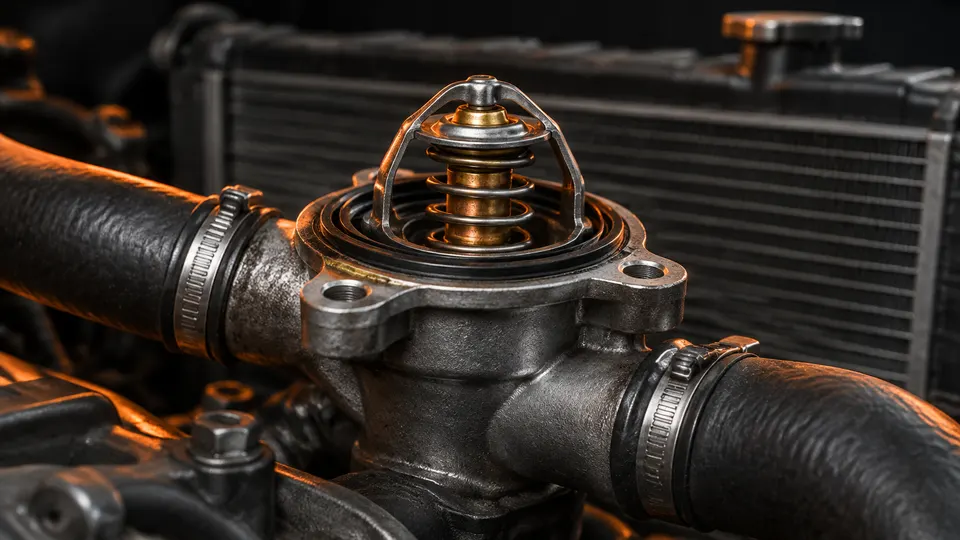
P0128 stands for "Coolant Thermostat (Coolant Temperature Below Thermostat Regulating Temperature)." Your engine has a thermostat, a valve that stays closed while the engine is cold so it warms up quickly. Once the coolant is hot, it opens and lets coolant flow to the radiator. The engine coolant temperature (ECT) sensor reports the temperature to the engine computer.
The engine computer watches how fast the coolant warms up. California's OBD II regulation requires the system to flag a thermostat problem if, within an approved time after starting, the coolant does not reach a temperature within 20 degrees Fahrenheit of the thermostat's rated regulating temperature [1]. The time limit and the exact target are set by each automaker and approved by regulators. This matters outside California too: the U.S. EPA notes that most automakers prefer to certify to California's OBD II design rules [2].
Carista, a maker of diagnostic apps, sums it up: the engine is not reaching operating temperature within the expected time [3]. P0128 means the engine runs too cool for too long; it is not an overheating code.
Is it safe to drive with P0128?
Usually, yes. An engine that runs a little cool will not hurt itself the way an overheating engine can. Carista rates P0128 as low severity [3]. Here is what you will likely notice and what to watch for:
- Weak heat. Carista lists weak or slow cabin heat, because the coolant does not get hot enough for the heater [3]. In winter that can mean slow defrosting, so give the windshield time to clear before you drive.
- Low or slow temperature gauge. The gauge may never reach its usual spot, or it takes much longer to get there.
- Worse fuel economy. A cool engine runs richer to stay smooth, so mileage usually drops.
- Inspection. An active code keeps the check engine light on, and EPA guidance says a car passes the OBD check only when no trouble code commands the light on [4].
If the temperature gauge reads high, steam appears, or a coolant warning comes on, pull over and turn the engine off; that is overheating, not P0128. Also, if the check engine light starts flashing, read our guide to a flashing check engine light.
What causes P0128?
Most common first:
| Cause | Clue | Who can check it |
|---|---|---|
| Thermostat stuck open or opening early | Gauge low, heat weak, especially on the highway in cold weather | You can observe; replacement is moderate work |
| Faulty ECT sensor | Scanner reading disagrees with the real engine temperature | You with a scanner; a shop to confirm |
| Low coolant | Level below the mark in the reservoir when cold | You |
| Cooling fan running all the time | Fan runs right after a cold start | You can listen; a shop finds why |
| Cold weather with short trips or long idling | Code appears only in winter | You |
Carista says the code is nearly always caused by a thermostat stuck in the open position, and also names a faulty ECT sensor and cold weather with long idling or short trips [3]. Haynes adds a useful caution: a thermostat often plays a role, but proper inspection prevents unnecessary replacement [5].
Weather matters because the test has limits. The same California regulation lets automakers disable thermostat monitoring below 20 degrees Fahrenheit, and to suspend it under conditions that could cause a false result, such as idling for more than half of the warm-up time [1]. Even so, a car that only makes short winter trips can be borderline.
How do you diagnose P0128?
Start with checks that cost nothing. Before you replace a thermostat, make sure the temperature reading itself is true.
1. Check the coolant, cold. Only open the reservoir or radiator cap when the engine is fully cold; hot coolant is under pressure. If the level is low, top it up with the coolant type in your owner's manual and look for leaks.
2. Scan. Write down all codes and the freeze frame. The freeze frame shows the coolant temperature when the code set, which tells you how far short the engine was. Our guide on how to use an OBD2 scanner shows where to find it.
3. Watch live data from a cold start. On a scanner that shows live data, watch coolant temperature as the engine warms. A temperature that climbs, then stalls well below normal on the highway, fits a thermostat that is stuck open.
4. Check the sensor. Carista suggests comparing the ECT reading with an infrared thermometer pointed at the thermostat housing [3]. If the scanner says the engine is cool but the housing is clearly hot, suspect the sensor or its wiring rather than the thermostat. Keep hands, sleeves, and tools clear of the fan and belts while the engine runs.
5. Listen for the fan. If the cooling fan runs from a cold start, the engine will warm slowly. That points to a fan control problem, which is shop work.
How do you fix P0128, and what does it cost?
The fix depends on what step 4 showed: a new thermostat (and usually its gasket), a new ECT sensor, a coolant top-up and leak repair, or a fan control repair. Carista recommends a thermostat that meets the original equipment specification, and refilling and bleeding air from the cooling system after the job [3]. Air left in the system can cause overheating later, which is why many owners leave this to a shop.
We do not list prices because we could not find a reliable, current U.S. source. These factors drive the cost:
- Thermostat location. On some engines it sits at the top and is easy to reach. On others it is buried under intake parts.
- Coolant. The system is drained and refilled with the correct coolant, and bled of air.
- Sensor vs. thermostat. A sensor is often quicker to replace than a thermostat, which is why testing first saves money.
- Fan problems. A fan that runs constantly needs its control circuit diagnosed.
After the repair, clear the code and drive. Clearing the code is not a repair; if the engine still warms too slowly, P0128 returns. Clearing also resets readiness monitors, and EPA guidance lists code clearing as a reason a car arrives "not ready" for inspection [4].
Does P0128 show up with other codes?
Sometimes. Because the ECT sensor is part of the story, a sensor circuit code alongside P0128 points toward the sensor or wiring. A cool-running engine also changes fuel control, so check all codes before you decide. If the light also shows lean or rich codes, such as P0171, fix the warm-up problem first and see whether the others clear. You can look up any extra code with our code lookup tool or browse the trouble code index.
Frequently Asked Questions
Can low coolant cause P0128?
Yes. Low coolant can leave the temperature sensor reading air or cooler coolant, so the engine looks like it is warming too slowly. Check the level only with the engine cold. If it keeps dropping, find the leak, because a coolant leak can lead to overheating.
Why does P0128 only come on in winter?
Cold air and cold coolant make a weak thermostat show up. A thermostat that opens a little early may still let the engine reach temperature in summer, but not in winter. Carista lists cold weather with long idling or short trips as a cause on its own [3].
Is a new thermostat always the fix for P0128?
No. It is the most common fix, but a faulty ECT sensor, low coolant, or a fan that runs all the time can set the same code. Haynes warns that proper inspection prevents unnecessary replacement [5].
Can I replace a thermostat myself?
On many engines, yes, if you are comfortable with basic hand tools and the thermostat is easy to reach. The engine must be completely cold, the old coolant must be caught and disposed of properly, and the system has to be refilled and bled of air afterward. If the thermostat is buried under other parts, or you are unsure how to bleed the system, a shop is the safer choice.
Our Take
We think P0128 is a fair warning, not an emergency. The sources agree the thermostat is the usual cause, but they also point to the sensor, low coolant, and cold weather, so we would spend a little time with a scanner and live data before buying parts. If the sensor matches the real temperature and the engine still warms slowly, a thermostat is a reasonable bet, ideally one built to the original specification and installed with a proper coolant bleed. We would not ignore it through a winter: weak heat makes defrosting slower, and the lost fuel economy adds up. And we would always keep P0128 separate from overheating, which means pulling over.
Sources
- Cal. Code Regs. Tit. 13, § 1968.2: Malfunction and Diagnostic System Requirements, 2004 and Subsequent Model-Year Passenger Cars, Light-Duty Trucks, and Medium-Duty Vehicles and Engines. Legal Information Institute (Cornell Law School), 1968.
- On-Board Diagnostic (OBD) Regulations and Requirements: Questions and Answers. U.S. Environmental Protection Agency, 2003.
- P0128 Code. Carista, 2026.
- Performing Onboard Diagnostic System Checks as Part of a Vehicle Inspection and Maintenance Program. U.S. Environmental Protection Agency, 2001.
- OBD2 Codes List: Your Go-To Reference. Haynes, 2026.
This is general information to help you understand your vehicle, not a substitute for a hands-on diagnosis. If a warning light is flashing or the car runs badly, stop driving and have it checked by a qualified technician. Spotted an error? Tell us.
Keep Reading
P0420 on Nissan: Campaigns, Sensor Names and What to Check
P0420 on a Nissan: the Sentra SULEV emission campaign, how Nissan names its A/F and rear O2 sensors, what to check first, and when a dealer visit is free.
P0430 Code: Catalyst Efficiency Below Threshold (Bank 2)
P0430 means the Bank 2 catalytic converter on a V6 or V8 tests below its limit. See if it is safe to drive, what causes it, how to check it and what fixes cost.
P0430 on Ford: Recall 24E04, Bulletins and What to Check
P0430 on a Ford truck may be a software calibration issue. See Emission Recall 24E04 for F-150 hybrids, the 7.3L bulletins, safety and what to check first.
P0442 Code: Small EVAP Leak Detected
P0442 means your EVAP system found a small fuel vapor leak, about 0.040 inch. Learn if it is safe to drive, the common causes, and the checks to do first.
P0455 Code: Large EVAP Leak Detected
P0455 means a large leak in the fuel vapor (EVAP) system, often a missing or loose gas cap. See what it means, how soon to fix it, causes, and first checks.
P0456 Code: Very Small EVAP Leak
P0456 means your EVAP system found a very small vapor leak. Learn what it means, if it is safe to drive, the usual causes, and the cheap checks to do first.