P0301 Code: Cylinder 1 Misfire Detected
Quick Answer
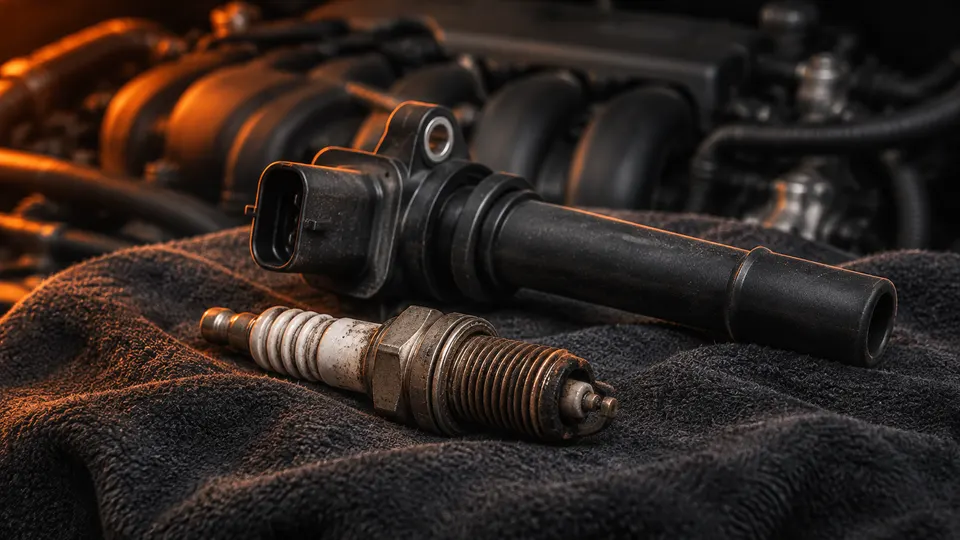
P0301 means the engine computer has caught cylinder 1 failing to burn its fuel often enough to set a fault. It is not safe to keep driving: if the check engine light flashes or the engine shakes, pull over and stop, because unburned fuel can overheat the catalytic converter. The most common causes are a worn spark plug or a failing ignition coil on cylinder 1, and a coil swap test often confirms which.
On this page
Key Takeaways
- P0301 points to one cylinder, which makes it easier to diagnose than a random misfire (P0300).
- A flashing check engine light means a misfire bad enough to damage the catalytic converter. Pull over and stop driving.
- Cylinder 1 is usually the cylinder nearest the front of the engine (the belt or chain end), but check your manual.
- Swapping the cylinder 1 coil with a neighbor is a free test: if the misfire moves, the coil is bad.
- If the misfire stays on cylinder 1 after the coil and plug check out, the injector or compression needs a technician.
P0301 at a glance
- Meaning
- Cylinder 1 Misfire Detected
- System
- Ignition & Misfire
- Severity
- Stop Driving A misfiring cylinder sends unburned fuel into the exhaust and can overheat the catalytic converter, so avoid driving it and do not drive at all if the check engine light is flashing.
- Common causes
- Worn or fouled cylinder 1 spark plug
- Failing ignition coil on cylinder 1
- Clogged, leaking or dead cylinder 1 fuel injector
- Low compression (burnt valve, worn rings)
- Vacuum leak near cylinder 1
- Applies to
- Generic OBD-II code: same meaning on all 1996 and newer cars and light trucks sold in the U.S.
What does P0301 mean?
P0301 is one of the cylinder codes P0301 to P0312, and the last digit names the cylinder: P0301 means the engine or powertrain control module detected a misfire in cylinder 1 [1]. The computer finds misfires by watching crankshaft speed. A cylinder that does not fire fails to push the crankshaft, which slows for an instant, and the crankshaft position sensor reports the dip [2].
California's OBD II regulation requires the system to identify the specific cylinder that is misfiring whenever it can [3]. A cylinder code like P0301 is good news in one way: it tells you exactly where to start looking. If you also have P0300, the random misfire code, the problem may be spreading or may involve something cylinders share.
Where is cylinder 1?
Most automakers number cylinders from front to back, so on an inline engine cylinder 1 is at the front, the end with the timing belt or chain. V engines and flat (boxer) engines vary by maker, and Ford V8s put cylinder 1 at the front of the driver's side [1]. On a V engine, the bank that holds cylinder 1 is called Bank 1. Confirm the layout in your owner's manual or a repair guide for your engine before you touch anything.
What symptoms come with P0301?
The check engine light is often the first sign, but most drivers also feel something. FIXD lists the typical symptoms as a rough idle, lower fuel economy, and stalling or hesitation, plus a fuel smell, black smoke or overheating depending on the cause [1].
- Rough or shaky idle. One cylinder not pulling its weight makes the engine shake most at a stop, when nothing else smooths it out.
- Hesitation when you accelerate. Some misfires appear only under load, so the stumble shows up when you press the pedal.
- Fuel smell or dark smoke. Fuel that does not burn in cylinder 1 leaves through the exhaust.
- A light that comes and goes. Some misfires only happen cold, wet or under load, so the code may set and then go quiet for a while.
None of these symptoms tells you the cause by itself. They do tell you when to note conditions, such as whether the shake happens cold or warm, which helps the diagnosis below.
Is it safe to drive with P0301?
No. P0301 is a stop driving code. FIXD's answer is to avoid driving with it, because the misfire can damage the engine and catalytic converter and can cause stalling or power loss [1].
If the check engine light is flashing or the engine shakes badly, pull over where it is safe, turn the engine off and have the car towed. A flashing light is not random. California's OBD II rule requires it to blink once per second while the engine is misfiring at a level that can damage the catalytic converter [3]. The unburned fuel from cylinder 1 burns in the exhaust instead. Ford's 2007 F-550 owner guide warns that the resulting exhaust heat can damage the converter and other parts, possibly causing a fire [4]. Our flashing check engine light guide explains the warning in full.
With a steady light and a smooth engine, limit driving to a short, gentle trip to get it checked. No towing, no long highway runs.
What causes P0301?
Because only one cylinder is involved, the parts that serve cylinder 1 alone come first. FIXD lists the spark plug, plug wire or ignition coil, the fuel injector, a vacuum leak, sensors, the head gasket and the catalytic converter among the possible causes [1].
| Cause | How it affects cylinder 1 | What points to it |
|---|---|---|
| Worn or fouled spark plug | Weak or no spark | Worn electrode, carbon or oil on the plug |
| Failing ignition coil or plug wire | Spark too weak under load | Misfire moves when you swap coils |
| Clogged or dead fuel injector | Too little fuel in that cylinder | Coil and plug check out; no regular clicking |
| Vacuum leak near cylinder 1 | Extra air leans out that cylinder | Hissing near the intake, worse at idle |
| Low compression | Burnt valve, worn rings or head gasket | Low reading on a compression test |
| Oil in the cylinder | Oil fouls the plug | Wet, oily plug on cylinder 1 |
Start with the cheap parts that serve only cylinder 1: the plug, the coil and its connector. Problems that affect every cylinder, such as low fuel pressure, usually set P0300 or several cylinder codes instead. A rough idle is often the first thing drivers notice; see what causes a rough idle.
How do you diagnose P0301?
Work from the free checks toward the tests that need tools. Keep the code stored until you have written down the freeze frame, because clearing it erases that record [2].
- Scan and save. Record all codes and the freeze frame data (engine speed, load and temperature when it set). The OBD2 scanner guide shows how.
- Look first. With the engine off and cool, check the cylinder 1 coil connector, the plug wire if there is one, and nearby vacuum hoses.
- Check the plug. Remove the cylinder 1 spark plug and look for carbon or oil buildup or a worn electrode [1].
- Swap the coil. Move the cylinder 1 coil to a cylinder that is not misfiring, clear the codes and drive. If the misfire moves with the coil, you have found the problem [1] [2].
- Hand off the rest. If the misfire stays on cylinder 1, the injector, fuel pressure and compression are next. Have a qualified technician check those, especially on direct injection engines, which run very high fuel pressure.
How do you fix P0301, and what does it cost?
Replace whatever the tests point to: the spark plug, the coil, a plug wire, a cracked vacuum hose, the injector, or engine parts if compression is low. Many owners replace all spark plugs as a set when one is worn, since they have the same mileage. We found no current, reliable price range for November 2026, so here is what drives the cost instead:
- The part. A spark plug or coil is a small job compared with an injector or valve work.
- Access. On some engines the cylinder 1 plug and coil are easy to reach; on others, parts must come off first, which adds labor.
- Damage from driving on it. A long misfire can harm the catalytic converter, which can later set P0420 and turns a small repair into a large one.
After the repair, clear the code and drive normally. Clearing a code does not fix anything. The check engine light can also go out on its own after three drive cycles in similar conditions without the misfire [3]. For inspection, a car with the light on will not pass a California Smog Check, and the readiness monitors need normal driving to complete [5].
Which vehicles get P0301 most often?
We found no public data that ranks vehicles by P0301. Bulletins show how a single cylinder can be singled out, though. A General Motors bulletin for 2008 to 2009 Chevrolet Silverado Hybrid and Tahoe Hybrid trucks with the 6.0L engine describes oil deposits on the number 1 spark plug that can cause a cylinder 1 misfire and set P0300 or P0301, traced to a worn number 1 cam bearing [6]. For a wider GM bulletin about misfires, see P0300 on Chevrolet, and use the code lookup tool for any other codes you find.
Frequently Asked Questions
Can a bad spark plug cause P0301?
Yes. A worn or fouled cylinder 1 spark plug is one of the most common causes. Pull it and look for carbon, oil or a worn electrode [1]. Oil on the plug means oil is getting into the cylinder, which a new plug alone will not fix.
What is the difference between P0300 and P0301?
P0301 names cylinder 1. P0300 means the misfires are spread across cylinders or cannot be tied to one [3]. Both carry the same safety advice: stop driving if the light flashes.
Can I drive a short distance with P0301?
Only if the light is steady and the engine runs smoothly, and only gently to get it checked. If the light flashes or the engine shakes, pull over and stop. FIXD advises against driving with P0301 at all [1].
Our Take
P0301 is one of the friendlier misfire codes to chase, because the computer has already told you which cylinder to look at. We would still treat it as a stop driving code: a flashing light means the catalytic converter is taking damage, and the sources we cite agree that is no time to push on. Once the car is safe, the order of work is clear. Save the freeze frame, look at the cylinder 1 plug and connector, then swap the coil. That swap costs nothing and settles the most common question. If the misfire refuses to move, stop buying parts and let a technician test the injector and compression.
Sources
- P0301 Engine Code: Cylinder 1 Misfire Detected. FIXD, 2024.
- Fault Code P0300 Misfire: How to Fix it Yourself (2026). Haynes, 2026.
- Title 13, California Code Regulations, Section 1968.2, Malfunction and Diagnostic System Requirements (OBD II), Final Regulation Order. California Air Resources Board, 2002.
- 2007 F-550 Owner's Guide. Ford Motor Company, 2007.
- Smog Check: When you need one and what's required. California Bureau of Automotive Repair.
- Preliminary Information PIP4525D: Hybrid, SES Light, Misfire, Oil Consumption and Fouled 1 Spark Plug. General Motors via NHTSA, 2013.
This is general information to help you understand your vehicle, not a substitute for a hands-on diagnosis. If a warning light is flashing or the car runs badly, stop driving and have it checked by a qualified technician. Spotted an error? Tell us.
Keep Reading
P0420 on Nissan: Campaigns, Sensor Names and What to Check
P0420 on a Nissan: the Sentra SULEV emission campaign, how Nissan names its A/F and rear O2 sensors, what to check first, and when a dealer visit is free.
P0430 Code: Catalyst Efficiency Below Threshold (Bank 2)
P0430 means the Bank 2 catalytic converter on a V6 or V8 tests below its limit. See if it is safe to drive, what causes it, how to check it and what fixes cost.
P0430 on Ford: Recall 24E04, Bulletins and What to Check
P0430 on a Ford truck may be a software calibration issue. See Emission Recall 24E04 for F-150 hybrids, the 7.3L bulletins, safety and what to check first.
P0442 Code: Small EVAP Leak Detected
P0442 means your EVAP system found a small fuel vapor leak, about 0.040 inch. Learn if it is safe to drive, the common causes, and the checks to do first.
P0455 Code: Large EVAP Leak Detected
P0455 means a large leak in the fuel vapor (EVAP) system, often a missing or loose gas cap. See what it means, how soon to fix it, causes, and first checks.
P0456 Code: Very Small EVAP Leak
P0456 means your EVAP system found a very small vapor leak. Learn what it means, if it is safe to drive, the usual causes, and the cheap checks to do first.